Model · Meta
Muse Wonder
Meta's frontier model arrived on 2026-10-12 in two versions that share a name, and the
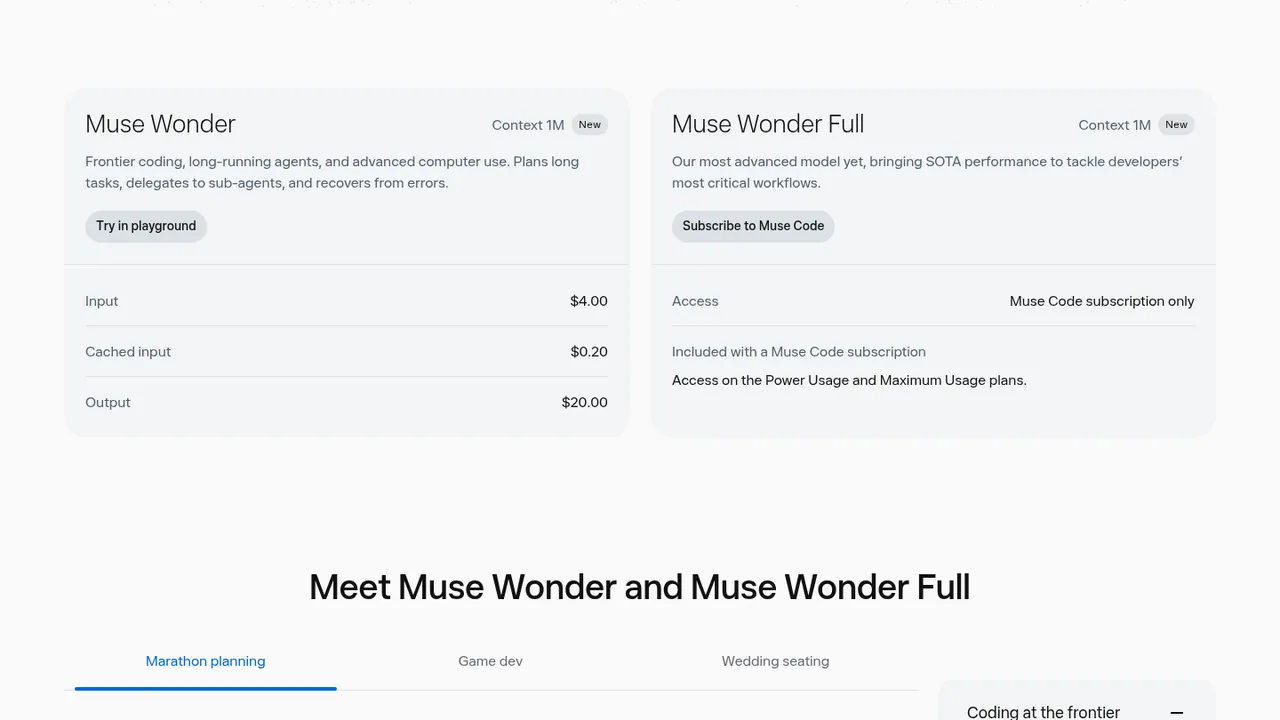
difference decides what you pay: Muse Wonder is sold per token — $4 in, $20 out per
million — while Muse Wonder Full is not sold at all, only included with a Muse Code
subscription from $50 a month. Meta's launch table leads with the Full column, which is why several
headlines quote a score the cheaper model did not earn.
On the independent index the two land at 56 and 52, against 58 for Claude Opus 5.5 at the same price
as Muse Wonder. What Meta is not is the cheap option this time: the previous Muse models cost a third
as much, and this page has the ladder.
The facts
| Field | Value |
|---|---|
| Model | Muse Wonder Meta's frontier reasoning model, released 2026-10-12 |
| The other model | Muse Wonder Full Stronger, subscription-only, not on OpenRouter |
| OpenRouter id | meta/muse-wonder The only route that bills per token |
| Price | $4.00 in / $0.200 cached / $20.00 out Per million tokens, identical on OpenRouter and Meta's own page |
| Context | 1.05M tokens 1,048,576 |
| Longest answer | 943,718 tokens The largest output ceiling on this site |
| Inputs | Text, image, video, audio, files Output is text |
| Moderation | Applied by OpenRouter 141 of the 465 catalogue entries carry the flag |
openrouter.ai/api/v1/models Verified 2026-10-16 Meta's own model page lists the same three prices.Every figure on this page carries the date it was read; the model page carries the live ones. What a subscription actually buys
Muse Code is where most people will meet this model, and the tiers do not differ by model alone — the $5 plan reaches Muse Wonder, and nothing below $50 reaches Muse Wonder Full.
| Plan | Price | What it allows |
|---|---|---|
| Everyday Usage | $5/month | 10–50 prompts every 5 hours, image and video uploads included, voice mode, web search |
| High Usage | $15/month | 5x the Everyday allowance, more multimodal inputs |
| Power Usage | $50/month | 20x the Everyday allowance, early access, larger uploads · The cheapest tier that reaches Muse Wonder Full |
| Maximum Usage | $200/month | 80x the Everyday allowance |
The Muse app itself is free and separate: Meta's own note is that Muse Wonder will reach it for subscribers first. The developer route is the one that bills per token.
Muse Wonder and Muse Wonder Full are not the same model
Meta's launch table prints Muse Wonder Full in the first column and Muse Wonder in the second, so a number quoted from the table's leading column belongs to the model that requires the $50 plan. On the independent index the gap is four points (56 against 52), and the cheaper model is the faster one (181 output tokens a second against the Full model's unpublished figure).
Muse Wonder Full is not on OpenRouter and has no per-token price. Everything else on this page is about the model you can actually call.
What the benchmarks say, and who says it
Meta's own evaluation covers 12 areas and claims state-of-the-art results on several of them, from agentic computer use (OSWorld V2.1) to ultra-long-horizon engineering (SWE-Marathon) and legal agent work (Harvey LAB-AA). Those are vendor figures on vendor test sets, and Meta's page publishes them in a grid that leads with the Full column.
The third-party view is narrower and easier to compare: Artificial Analysis runs the same suite across models and publishes a single index, a speed and a cost per task.
| Model | AA Intelligence Index | Output speed | Cost per index task |
|---|---|---|---|
| Claude Opus 5.5 max with fallback | 58 | 95 tok/s | $5.98 |
| Muse Wonder Full max, not on OpenRouter | 56 | not published | not published |
| GPT-6 Astra max | 53 | 45 tok/s | $3.26 |
| Muse Wonder max | 52 | 181 tok/s | $4.52 |
| Muse Spark 1.3 max | 48 | 122 tok/s | $1.60 |
Artificial Analysis Intelligence Index v4.3.2, read 2026-10-16. The index version matters: a score quoted from another model page may come from a different revision of the suite.
Calling it
On OpenRouter the id is meta/muse-wonder, the same three prices apply, and OpenRouter
applies moderation — a flag 141 of the 465 catalogue entries carry and that Muse Wonder's own
open-weight sibling does not. Web search is billed separately at $
0.0025 per search, a field almost no other model on the catalogue declares.
curl https://openrouter.ai/api/v1/chat/completions \
  -H "Authorization: Bearer $OPENROUTER_API_KEY" \
  -H "Content-Type: application/json" \
  -d '{
    "model": "meta/muse-wonder",
    "messages": [{ "role": "user", "content": "Read this lease and list every clause that costs me money." }],
    "max_tokens": 4000
  }'
Meta's own API takes the same shape through an OpenAI-compatible client, and its model page is the source for the subscription table above.
Is it on OpenCode?
No. OpenCode Zen and Go carry Muse Spark 1.3 and 1.2 — including a contributor tier that discounts in exchange for training on your data, and free routes — but not Muse Wonder. Someone searching for Muse Wonder on OpenCode is looking at a family whose frontier member is not there yet.
Where the discussion is
The launch thread is the readable one: 669 points and 381 comments on Hacker News, read 2026-10-16. Two of its arguments run through everything on this page — whether the ranking is real, and whether Meta has stopped competing on price.
“I'm sorry zuck, i wasn't familiar with your game — 2nd place model on aa according to them, losing only to opus 5.5 is really really not bad”
the ranking question, from the top comment
“unlike other Meta models this one seems to take a pretty big jump in pricing, as opposed to the prior ones, where they typically came out at a highly discounted price compared to every other model”
the pricing question, which the family table below answers with numbers
Elsewhere the conversation is spread across venues that do not have a readable API. The links are the honest version of a summary:
- Hacker News — 669 points, 381 comments
- r/LocalLLaMA — search, newest first by score
- r/singularity — search
- X — live search
Meta's week, and what it says about the price
Three days after Muse Wonder, Meta released Muse Spark Open — open weights for a coding-tuned model, 816B parameters with 42B active, gated behind a manual access request on Hugging Face and licensed under Meta's own Muse Model License rather than an OSI one. It runs on OpenRouter at $1.25 / $4.25.
Read as a price list, the family shows what changed: every earlier Muse model was the cheap option in its bracket, and Muse Wonder is not.
| Model | Input / 1M | Output / 1M | Note |
|---|---|---|---|
| Muse Wonder | $4.00 | $20.00 | Frontier tier; on both Meta's API and OpenRouter |
| Muse Spark 1.3 | $1.25 | $4.25 | |
| Muse Spark 1.3 Contributor | $0.10 | $0.20 | Meta may train on the data |
| Muse Spark Open | $1.25 | $4.25 | Open weights, gated, released 2026-10-15 |
| Muse Glimmer 30B | $0.30 | $1.20 |
Meta's API prices and the OpenRouter catalogue agree on every row above, read 2026-10-16. A model that is one row off this table — the contributor tier at $0.10 — is the one whose data Meta may train on.
Where to go next
- Muse Wonder in the model directory — live price, context window and cost estimates
- Muse Wonder vs Claude Opus 5.5 — the same $4 / $20, six index points apart
- Muse Spark Open — the open-weight sibling, gated
- Every model this site tracks — 5 of the Muse family included
Muse Wonder FAQ
Is Muse Wonder a new model, or a new way of using one?
A model. Meta's frontier reasoning model, released 2026-10-12, sold through Meta's own API, a Muse Code subscription and OpenRouter. The Muse app and Muse Code are the products around it; Muse Wonder itself is the weights.
How much does Muse Wonder cost?
Through an API: $4 per million input tokens, $0.20 cached, $20 output — the same on OpenRouter and on Meta's own model page. Through Muse Code the model is included from the $5/month tier, and the stronger Muse Wonder Full needs the $50 tier.
What is the difference between Muse Wonder and Muse Wonder Full?
Full is the stronger model and is not sold per token: it comes with Muse Code's Power Usage ($50) and Maximum Usage ($200) plans. Meta's launch benchmark table leads with the Full column, so a headline number quoted as "Muse Wonder" is often the Full model's.
Is Muse Wonder on OpenCode?
No. OpenCode Zen and Go carry Muse Spark 1.3 and 1.2 (including a contributor tier and free routes), not Muse Wonder. On OpenRouter the id is meta/muse-wonder.
Does Muse Wonder have open weights?
Muse Wonder does not. Meta released a separate open-weight model the day after, Muse Spark Open (816B total, 42B active), gated behind a manual request on Hugging Face under Meta's own Muse Model License rather than an OSI licence.
How good is Muse Wonder, according to someone other than Meta?
Artificial Analysis puts it at 52 on its Intelligence Index against 58 for Claude Opus 5.5, 56 for Muse Wonder Full and 53 for GPT-6 Astra, at $4.52 per evaluation task and 181 output tokens a second. Meta's own table publishes wins it does not share; both are linked, and neither is a measurement of yours.
openrouter.ai/api/v1/models · dev.meta.ai/models/muse-wonder · artificialanalysis.ai Verified 2026-10-16 Launch post: research.meta.ai/blog/muse-wonder New model pages and repricings, one email per week. Unsubscribe in one click.