HunterAlphaHub
OpenRouter model reference Facts from the public catalogue, dated and labelled
Jev Laya Muse Open Verified
2026-10-16

Model reference · verified 2026-10-17

Muse Spark Open, and the 493 GB question

Meta published the weights for Muse Spark Open on 15 October 2026: 816B total parameters with 42B active per token, native image, audio and video input, and a 1,048,576-token window. It is the most capable open-weight model a US lab has released, and it is also four hundred and ninety-three gigabytes before the KV cache. Both halves of that sentence are the story.

Weights under the Muse Model License On OpenRouter → Meta's model page →

  • 816B parameters, 42B active a sparse MoE: compute tracks the slice, memory tracks the whole
  • 493 GB NVFP4 weights before KV cache, per Apple's measurement
  • $1.25 / $4.25 per million tokens on OpenRouter; hosted is the route with no memory bill
  • 1,048,576 token context 943,718 tokens of output
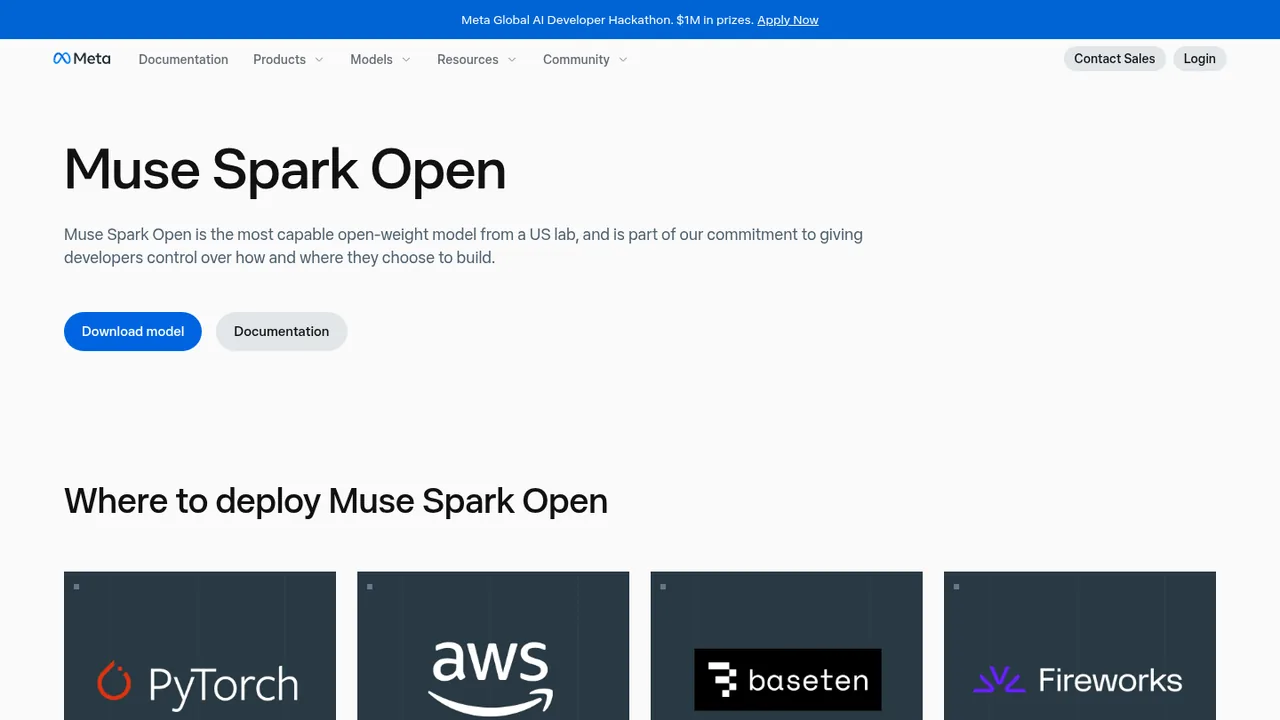
Meta's Muse Spark Open model page: the name, the one-line description and the deployment partners
The model page, and the deploy partners it lists dev.meta.ai · captured 2026-10-17 Open the page →
Video · YouTube
Muse Spark Open is HERE: What REALLY Takes to Run It? RepoChad · 7,456 views · 9 min Watch on YouTube →

The short version

What it is

A sparse mixture-of-experts transformer derived from the Muse Spark line, with additional safety post-training for standalone release. Text, image, audio and video in; text out. Meta positions it for agentic coding and long-horizon software work rather than chat.

What it costs

1.25 / 4.25 per million tokens on OpenRouter, with cached input at 0.15. Self-hosting is a hardware purchase: about 493 GB in NVFP4, or 1.65 TB of BF16 weights, before the KV cache.

What is new here

Not the frontier score — it is the fact that a model in this class leaves a lab's API at all. Meta says two M5 Ultra Mac Studios can hold it, and Apple measured more than 36 tokens per second on four of them. That is a deployment story, not a demo.

What is still hard

The weights are gated, the licence is not OSI, and the cheapest local build in the first 48 hours used two DGX Sparks and a 194.6 GiB quantization. The model is open; the hardware is not free.

What Meta says it scores

Meta's launch table, read 2026-10-17 Rival numbers are the same table's, on the same row — not a harness we ran

CategoryBenchmarkMuse Spark OpenFor scale
Agentic JobBench 61.8 Inkling 31.1 · Nemotron 3 Ultra 27.2
MCP-Atlas 89.2 Inkling 76.0 · Nemotron 3 Ultra 63.1
GDPval-AA v2 1401 Qwen3.8 1613 · GLM 5.3 1653 — the only row where Muse trails the listed rivals
Knowledge & Reasoning HLE-Diamond · no tools 26.1 Inkling 11.2 · Nemotron 3 Ultra 8.9
SciCode 58.5 GLM 5.3 59.0 · Mistral Large 4 54.2
AA-Omniscience 25 GLM 5.3 14 · Mistral Large 4 −5; a negative score means more wrong answers than right ones
Coding Terminal-Bench 2.1 · Terminus 2 agent 76.4 GLM 5.3 83.9 · Qwen3.8 82.0
DeepSWE 1.1 · best available / self-reported harness 60 GLM 5.3 67 · Mistral Large 4 62
Multimodal (with tools) ZeroBench 50.0 Inkling 14.0; the other four columns say not supported
BabyVision 80.2 Inkling 34.2; the rest not supported
SimpleVQA 73.6 Inkling 52.3; the rest not supported

Every row, and what each one does not measure →

Five ways to run it

RouteWhat it isMemorySource
BF16 referenceThe full-precision checkpoint, served on eight GPUs such as 8× B300.≈1.65 TB of weights; budget roughly 2 TB of VRAM for KV cache, activations and runtime overheadMeta cookbook
NVFP4 checkpointMost weights in 4-bit with some layers kept in BF16; serves on a single 4-GPU NVIDIA Blackwell node.≈537 GB of weightsMeta cookbook
MLX on Mac StudioThe desktop route: pipeline or tensor parallelism over two to four M5 Ultra machines.≈493 GB in NVFP4; two Macs give 1 TB of unified memory, four give 2 TBApple ML Research
Two DGX SparksA community recipe at IQ1_M on two GB10 nodes over llama.cpp RPC.194.6 GiB of weights, about 97 GiB per nodeAuthor's repository
HostedBaseten, Fireworks, Groq, Modal, Nebius, OpenRouter or Together AI — no local memory at all.None locally; billed per token, $1.25/$4.25 on OpenRouterMeta cookbook

Apple's four-Mac Studio run: 36+ tokens/s at 8,192 context (2026-10-16) The arithmetic behind each route →

What people built in the first 48 hours

Three of the four builds we hold; the fourth is on the builds page. Stars read 2026-10-17. A three-day-old model has a short list — the point of printing it now is that the list will look different in a week.

What Hacker News argued about

All five threads →

Questions readers actually ask

The next open-weight release, in one email

Muse Spark Open arrived with a launch post and a cookbook, which is the tidy version. The next one may arrive as a repository at midnight. Leave an email and we will send one note when a model appears, with the specs read from the catalogue.

One email per model. No newsletter, no forwarding, unsubscribe in one click.

Meta's cookbook → The gated weights The full reference What running it costs

Send us a link

A project built with Jev, a post, a video, a correction, a tip. We open the link, check it says what you said it says, and write the entry ourselves.

Required a link, and an email to reply to. Optional everything else.

Add context — all optional

One or two sentences about what it does, in your words. We write the entry ourselves.

Cost, latency, a benchmark — anything you measured. We attribute these to you.

We store what you type and email it to ourselves. No IP address, no user agent, no referrer — the same rule as the mailing list.

What happens to what you send →