Model reference · verified 2026-10-17
Muse Spark Open, specified
Muse Spark Open is the open-weight release of Meta's Muse Spark line: 816B parameters, 42B of them active per token, a 1M-token window and native image, audio and video perception. It shipped on 15 October 2026 with a launch post, a cookbook, seven hosted providers and a licence Meta calls open but not OSI. This page is the long version: the numbers, where each one comes from, and the parts the launch table leaves out.
Launch post 2026-10-15 Read 2026-10-17 research.meta.ai →
What it is
A sparse mixture of experts. Each token routes through a small subset of the 816B parameters, so the compute cost per token tracks roughly 42B, while the serving cost tracks all 816B because every expert has to be resident somewhere. That single sentence explains almost every surprising number on this page: the model is fast for its size and enormous for its speed.
Meta describes it as derived from the Muse Spark model released in August, with additional safety post-training so that it holds up as a standalone model without a system guardrail. The input side is natively multimodal — text, images, audio and video — and the output side is text. The perception encoders ship inside the checkpoint, which is part of why the file is this large.
| Field | Value |
|---|---|
| Maker | Meta Released 15 October 2026 under the Muse Model License. |
| Class | Sparse mixture-of-experts transformer Built for agentic coding and long-horizon software work; multimodal input, text output. |
| Parameters | 816B total · 42B active Compute tracks the active slice; serving still loads the full checkpoint. |
| Context | 1,048,576 tokens Output ceiling 943,718 tokens. |
| Modalities | Text · image · audio · video in; text out The perception encoders are part of the checkpoint. |
| Weights | Muse Model License Gated on Hugging Face behind a manual access request; not an OSI licence. |
| Hosted price | $1.25 / $4.25 per 1M tokens OpenRouter, read 2026-10-17. Cached input $0.15. |
| Launch partners | 7 hosted providers Baseten, Fireworks, Groq, Modal, Nebius, OpenRouter, Together AI — Meta's list. |
dev.meta.ai/models/muse-spark-open; meta-models/meta-oss-cookbook Verified 2026-10-17 Benchmarks: Meta's launch tablePrice: OpenRouter catalogue Three memory numbers, and why all of them are true
The most common argument about this release is about memory, and most of it is people quoting different numbers at each other. There are three, and they measure three different things. The chart below puts them on one scale.
The launch table, row for row
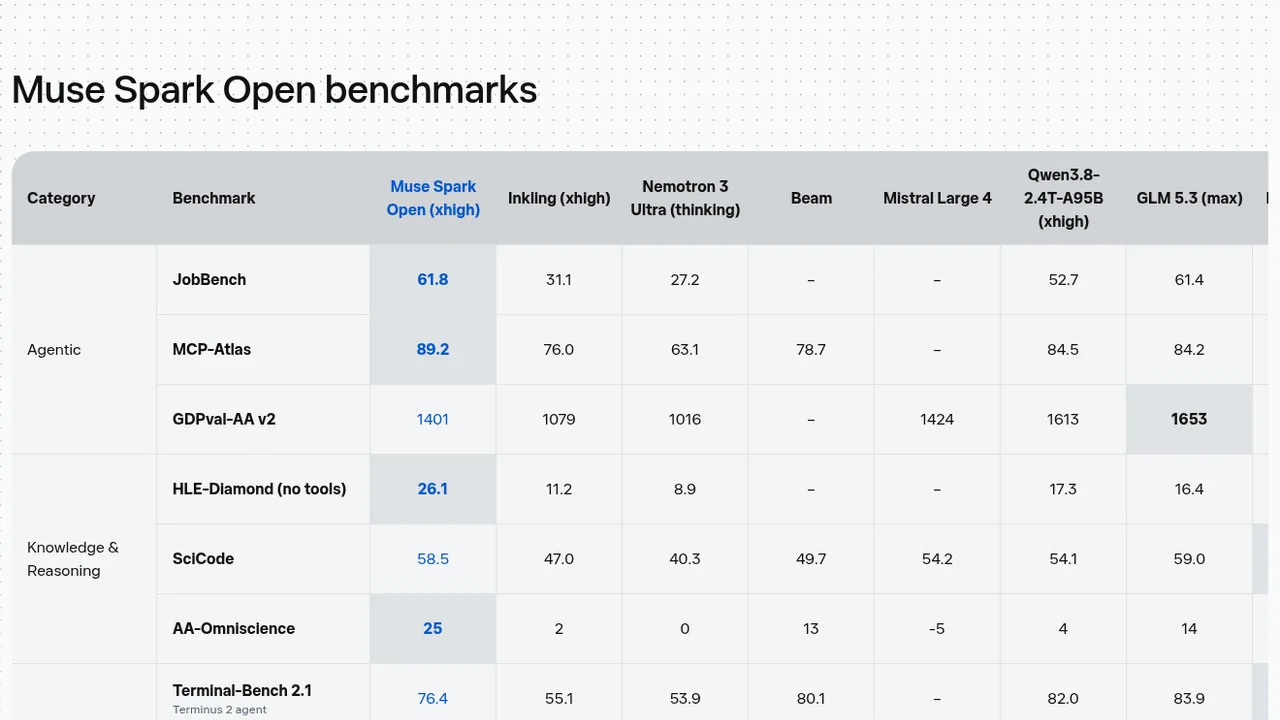
Meta's table compares Muse Spark Open against seven models, and the honest reading is that it wins some rows by a lot and loses others. The biggest leads are on the rows where the rivals are marked "not supported" — the multimodal benchmarks — which says as much about the comparison set as about the model. The clearest loss is GDPval-AA v2, where Qwen3.8 and GLM 5.3 both score higher.
| Category | Benchmark | Muse Spark Open | For scale |
|---|---|---|---|
| Agentic | JobBench | 61.8 | Inkling 31.1 · Nemotron 3 Ultra 27.2 |
| MCP-Atlas | 89.2 | Inkling 76.0 · Nemotron 3 Ultra 63.1 | |
| GDPval-AA v2 | 1401 | Qwen3.8 1613 · GLM 5.3 1653 — the only row where Muse trails the listed rivals | |
| Knowledge & Reasoning | HLE-Diamond · no tools | 26.1 | Inkling 11.2 · Nemotron 3 Ultra 8.9 |
| SciCode | 58.5 | GLM 5.3 59.0 · Mistral Large 4 54.2 | |
| AA-Omniscience | 25 | GLM 5.3 14 · Mistral Large 4 −5; a negative score means more wrong answers than right ones | |
| Coding | Terminal-Bench 2.1 · Terminus 2 agent | 76.4 | GLM 5.3 83.9 · Qwen3.8 82.0 |
| DeepSWE 1.1 · best available / self-reported harness | 60 | GLM 5.3 67 · Mistral Large 4 62 | |
| Multimodal (with tools) | ZeroBench | 50.0 | Inkling 14.0; the other four columns say not supported |
| BabyVision | 80.2 | Inkling 34.2; the rest not supported | |
| SimpleVQA | 73.6 | Inkling 52.3; the rest not supported |
Meta's launch table, read 2026-10-17 Harness rows: "Terminus 2 agent" and "Best available / self reported harness" are Meta's labels
What each deployment route actually needs
The launch table says what the model can do; the hardware table says who can use it. The spread is the widest of any model on this site: from a 194.6 GiB quant on two small NVIDIA nodes to 1.65 TB of BF16 weights on eight GPUs, with a four-Mac-Studio configuration in between.
| Route | What it is | Memory | Source |
|---|---|---|---|
| BF16 reference | The full-precision checkpoint, served on eight GPUs such as 8× B300. | ≈1.65 TB of weights; budget roughly 2 TB of VRAM for KV cache, activations and runtime overhead | Meta cookbook |
| NVFP4 checkpoint | Most weights in 4-bit with some layers kept in BF16; serves on a single 4-GPU NVIDIA Blackwell node. | ≈537 GB of weights | Meta cookbook |
| MLX on Mac Studio | The desktop route: pipeline or tensor parallelism over two to four M5 Ultra machines. | ≈493 GB in NVFP4; two Macs give 1 TB of unified memory, four give 2 TB | Apple ML Research |
| Two DGX Sparks | A community recipe at IQ1_M on two GB10 nodes over llama.cpp RPC. | 194.6 GiB of weights, about 97 GiB per node | Author's repository |
| Hosted | Baseten, Fireworks, Groq, Modal, Nebius, OpenRouter or Together AI — no local memory at all. | None locally; billed per token, $1.25/$4.25 on OpenRouter | Meta cookbook |
Meta's cookbook and Apple's ML Research post, read 2026-10-17 Apple: 36+ tokens/s on 4 M5 Ultra Mac Studios at 8,192 context
What the licence allows
The weights are free to download after a manual access request, and the licence is not Apache-2.0 or MIT. Meta calls it the Muse Model License with limited commercial terms and says it allows many developers to use the model for free. That sentence is doing real work: it is a permission with conditions attached, not a dedication to the public domain.
| Field | Value |
|---|---|
| Licence | Muse Model License Clicked through on the model card; the weights are gated. |
| OSI-approved? | No Meta describes limited commercial terms that allow many developers to use it for free. |
| Acceptable use | Separate policy The model card carries a use policy alongside the licence. |
| What it reaches | The weights and their outputs The cookbook code is Apache-2.0; the model is not. |
The practical reading for a team: shipping a product on top of the weights is a licence review, not a dependency decision. The cookbook's code is separately Apache-2.0, so the tooling around the model is easier to reuse than the model itself.
What Meta does not claim
- It is not a laptop model. NVFP4 is about 493 GB before the KV cache. The community SSD-streaming experiment reaches a 128 GB MacBook at about 4.4 tokens per second, which is a demonstration rather than a daily driver.
- It is not a chat model first. The launch material is about coding agents, tool loops and long-horizon work. Benchmarks for creative writing or open-ended conversation are absent.
- It is not a clean sweep. GDPval-AA v2, Terminal-Bench 2.1 and DeepSWE 1.1 all have rivals at or above its score in Meta's own table.
- It is not ungated. The Hugging Face card requires an access request; "open weights" here means weights you can obtain, not a file anyone can pull anonymously.
What this page cannot tell you
We have not run the model. Every number here is Meta's, Apple's, or a repository author's, and the only independent run we quote is the PR-review benchmark, which is itself one team's harness. Latency on your hardware, quality on your workload and the real cost of a hosted endpoint are all things this page cannot settle. The benchmark screenshot is a capture of Meta's page, not a test we performed.
Meta's cookbook → The model card Apple's MLX post Run it locally