HunterAlphaHub
OpenRouter model reference Facts from the public catalogue, dated and labelled
Jev Laya Fable 5.2 Verified
2026-11-13

Model topic · verified 2026-11-13

Claude Fable 5.2, and the $26 task

Short answer

Anthropic released Claude Fable 5.2 on 2026-11-09. It is the company's strongest model for hard reasoning and long-horizon agent work, with a 1M-token window, five effort levels and a list price of $8 in and $40 out per million tokens. It is also the clearest example this month of why the effort setting matters more than the headline model name: the same model can finish a task in a sensible budget or take 46.8 minutes and $26 at Max.

Released 2026-11-09 Anthropic's launch → On OpenRouter →

  • 64.6 AA Intelligence Index Max effort · #1 of 78
  • $8 / $40 per million tokens twice Claude Opus 5.5
  • 1M / 128K context / output text and image input
  • $26.54 per AA task at Max 46.8 minutes on average
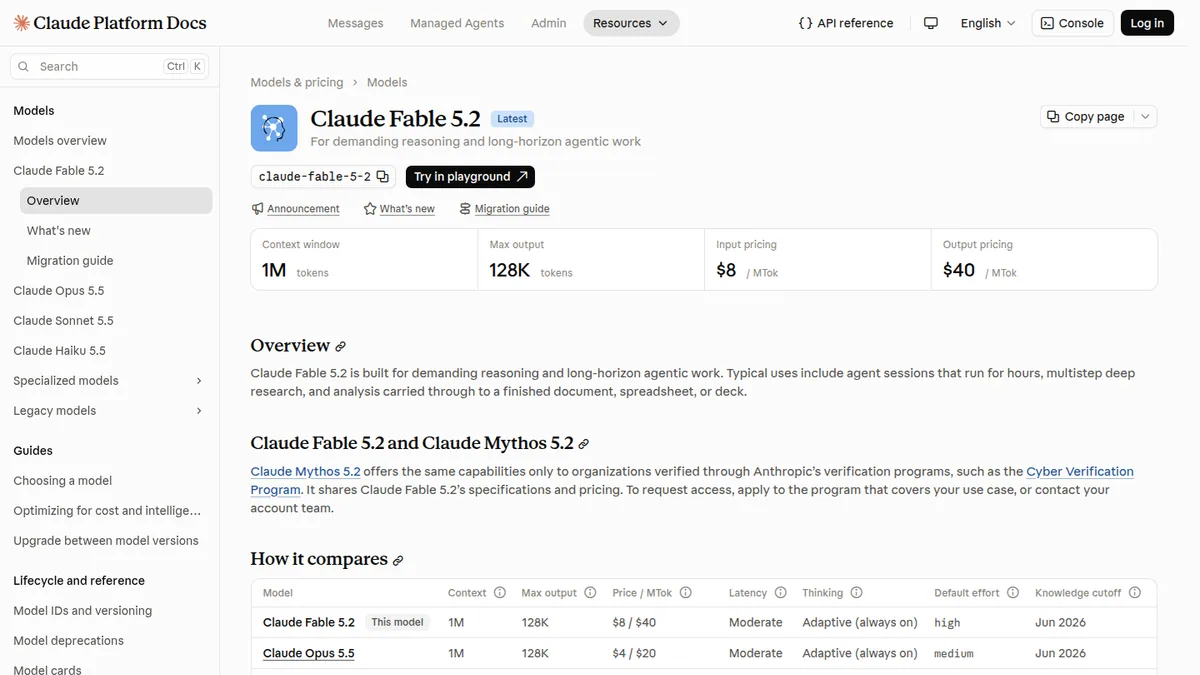
Claude docs Claude Platform documentation for Fable 5.2, showing the model name, 1M context, 128K output and $8/$40 pricing
The model card, on Anthropic's own docs Name, window, output ceiling, price and the Opus comparison in one frame Read the documentation →
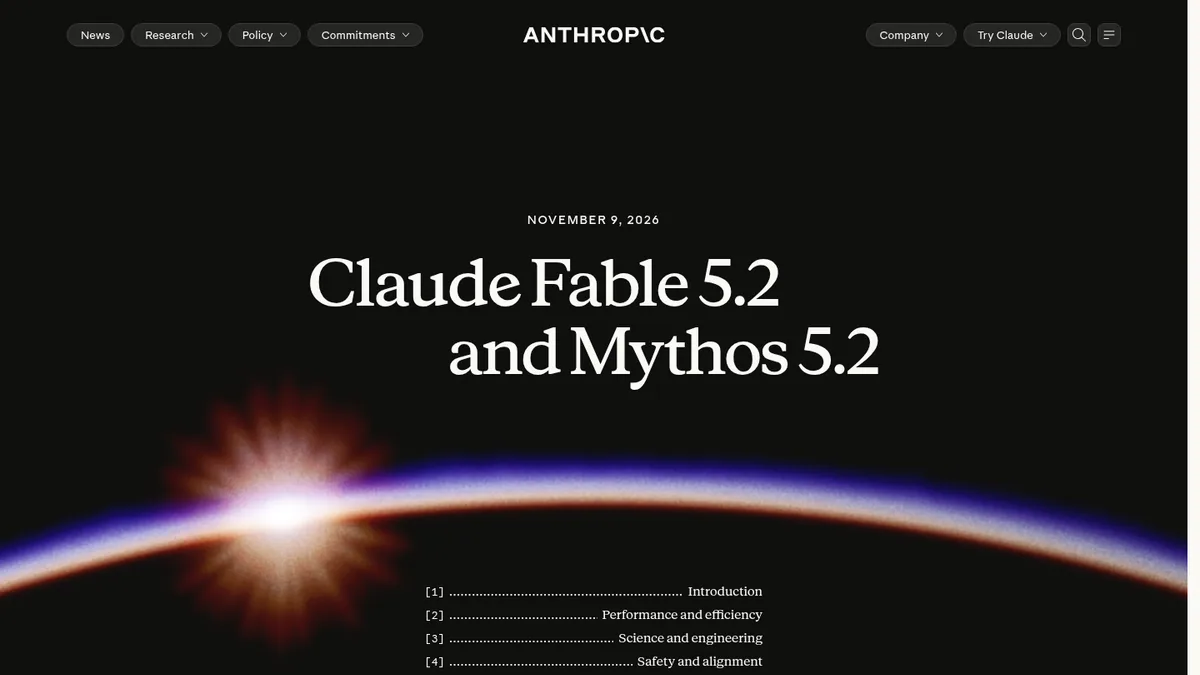
Anthropic · launch Anthropic's launch page for Claude Fable 5.2 and Claude Mythos 5.2, dated 9 November 2026
Fable 5.2 and Mythos 5.2 are one model with two access paths Mythos is gated for verified cyber and life-sciences work Read the launch post →

The short version

It is a deliberate step up

Anthropic positions Fable above Opus 5.5 for the hardest, longest-running work. The launch table has it ahead on coding, research, computer use, robotics, chart reading and hardware design. Several gains are large, not cosmetic.


It is not the default

Opus 5.5 has the same 1M-token window and the same 128K output ceiling at half the token price. Anthropic's own guidance says to start most coding and knowledge work on Opus, then move upward when the task needs it.

Effort changes the bill

Fable supports Low, Medium, High, Xhigh and Max. The API default is High. At Medium, Anthropic shows some tasks matching Opus at a fraction of the cost; at Max, Artificial Analysis measured $26.54 and 46.8 minutes per task.

The demo wall became the product

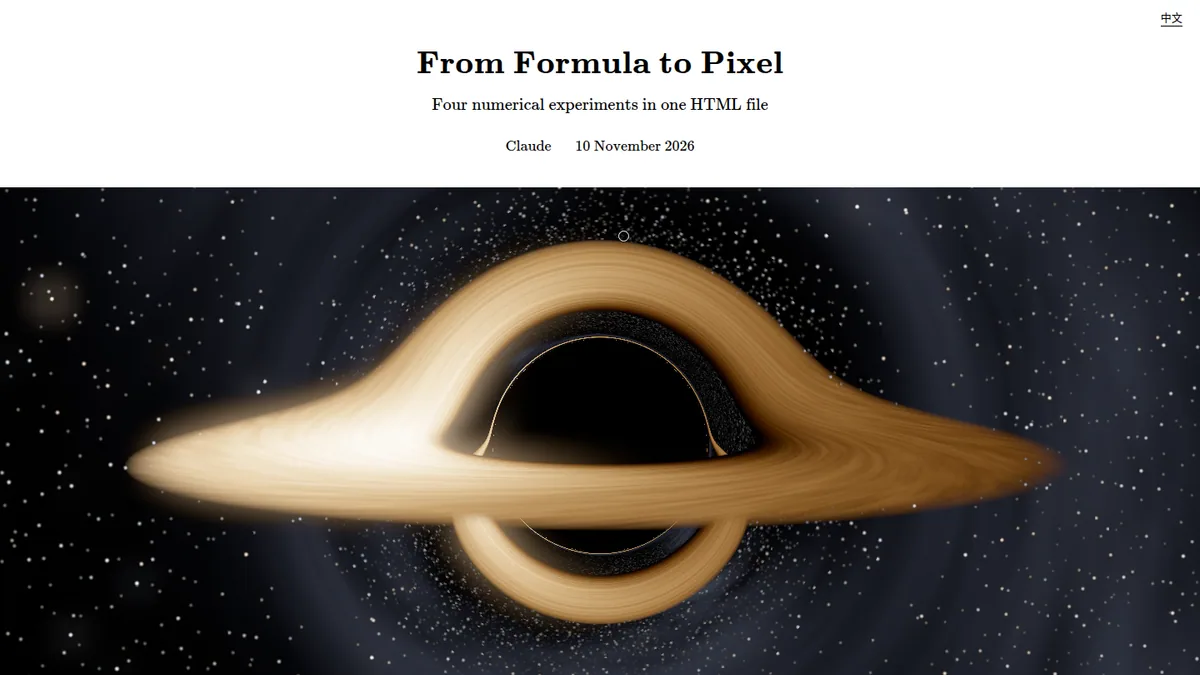
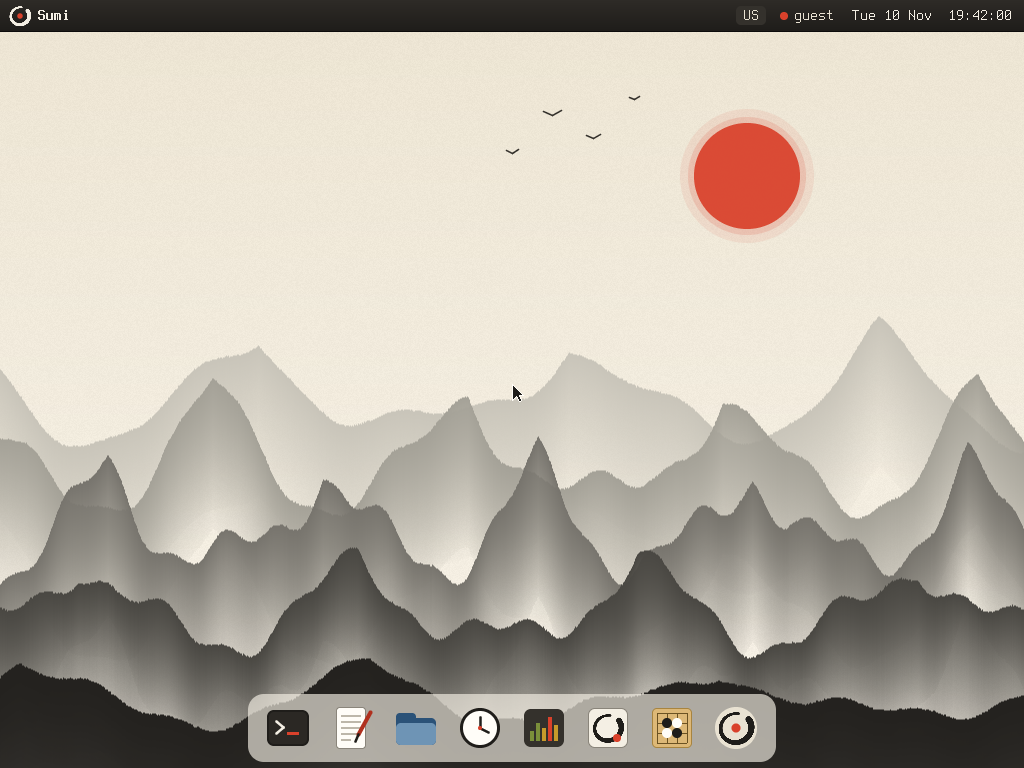
The first week produced playable shooters, a Van Gogh game, a walkable Rome, audio generators, medical explainers and a prototype operating system. The community index grew from 57 live works at launch to 165 by 2026-11-15. The entries that last publish source, tests or the bill.

The strongest demos are recipes

A finished project is easier to learn from when you can name the constraint behind it: one playable loop, one physical law, one cited source set or one local-only workflow. The new build guide turns eight of those patterns into starter prompts and acceptance checks.

What Anthropic says it scores

Anthropic's launch table, read 2026-11-13 Comparison scores are the same table's — not a harness we ran

BenchmarkFable 5.2Opus 5.5For scale
FrontierCode 2.0 · Agentic coding 49.1% · Xhigh 45.5% Fable 5.1 32.4% · Xhigh · GPT-6 Astra 42.8%
FrontierSWE v2 · Agentic coding 69.9% 62.3% Fable 5.1 56.3% · GPT-6 Astra 65.5%
AutomationBench · Business workflows 51.4% 42.5% Fable 5.1 31.4% · GPT-6 Astra 41.4%
WANDR · relaxed score · Agentic search 82.1% 72.3% Fable 5.1 68.7%
RoboDojo Sim · Robotics 64.9% 39.4% Fable 5.1 27.6% · GPT-6 Astra 29.8%
Humanity's Last Exam · with tools · Reasoning 74.2% 67.7% Fable 5.1 65.6% · GPT-6 Astra 57.2%

These are vendor-selected tasks with safeguards on and each model's highest available effort, unless a row says otherwise. The full table and its caveats →

The result behind the demo wall

1,000 agents, one formal proof, 28.7 hours

Anthropic's most revealing launch demo is not a game. It ran 1,000 Fable 5.2 agents in separate sandboxes against a shared SQL database and asked them to formalize Fermat's Last Theorem in Lean. The run reproduced the proof in 28.7 hours, using one-third as many output tokens as the earlier research run and producing a proof one-seventh as long.

The same setup using Opus 5.5 completed 26% of the formalization in 18 hours and barely moved after 30, according to Anthropic. That comparison is vendor-run, not independent. It still shows what the premium is for: long-horizon coordination, not a better one-line answer.

Anthropic multi-agent write-up, read 2026-11-13 Read the harness and safety setup →

Agents
1,000
Wall time
28.7 h
Output tokens
1/3
Proof length
1/7

The number that changes the decision

One model, five bills

Fable's effort levels are not cosmetic. Anthropic says Medium is the default in Claude apps and Claude Code, and that it can match Opus 5.5's top score on some tasks for a fraction of the cost. The API default is High. Xhigh produced the 49.1% FrontierCode headline. Max is what Artificial Analysis ran when it measured 46.8 minutes and $26.54 per task.

Start at High. Try Medium whenever the client allows it. Save Xhigh for a task that has already defeated a cheaper attempt, and treat Max as an unattended purchase rather than a default setting.

The effort and cost guide The catalogue row

  1. Low A bounded lookup, extraction or classification where the answer is easy to check.
  2. Medium Daily coding, research with a clear question, and product work where speed still matters.
  3. High The first sensible setting for long-horizon coding, agent work and hard analysis.
  4. Xhigh A difficult migration, a bug that survived cheaper attempts, or an agent run where a failed answer costs more than the tokens.
  5. Max A benchmark, a one-off investigation, or an unattended job whose result is worth tens of dollars.

What the price actually means

A million input tokens and a million output tokens cost $8 and $40 respectively. That is double Opus 5.5 in both directions. A cached read is $0.20, so long agent sessions with a stable system prompt and tool list are far cheaper than the fresh-input rate suggests. A five-minute cache write is $10 and a one-hour cache write is $16.

RouteInput / 1MOutput / 1MWhen it makes sense
Standard$8$40Hard agent work and deliberate frontier tasks.
Cache read$0.2$40A stable prompt, tool schema or repository prefix reused across a run.
Fast mode$16$80A person is waiting and the measured speedup is worth double the token bill.
Batch API50% off50% offWork that can wait; Anthropic lists a 50% discount on input and output.

Anthropic pricing page, read 2026-11-13 OpenRouter lists the same base token rates and effort controls

What people built in launch week

The interesting part is not that a model can make a game. It is the range of evidence: one project publishes its tests, another publishes the source as the agent left it, and a third publishes the token bill. A community index already tracked 165 live works by 2026-11-15. The eight below are a cross-section; the curated wall now holds 45.

All 45 curated demos, filterable by kind →
Eight build recipes behind the wall →

The buying question

Fable 5.2 or Opus 5.5?

The two models have identical context and output ceilings. The real difference is the price and the intended difficulty of the work. Start on Opus. Move to Fable when a task needs the harder reasoning tier, and move back when it does not.

The full comparison Opus on OpenRouter

ModelPrice / 1MDefault effortFit
Fable 5.2$8 / $40HighThe hardest, longest jobs
Opus 5.5$4 / $20MediumThe strongest daily driver
Sonnet 5.5$2 / $10HighWell-scoped product work

What this does not prove

Questions people ask

What is Claude Fable 5.2?

Claude Fable 5.2 is Anthropic's frontier model released on 9 November 2026 for demanding reasoning and long-horizon agentic work. Anthropic's capability table lists text and image input and text output; OpenRouter also advertises file input. It has a 1M-token context window and a 128K output ceiling. Anthropic positions it above Opus 5.5 for the hardest open-ended work, not as the default for every task.

How much does Claude Fable 5.2 cost?

The list price is $8 per million input tokens and $40 per million output tokens. Cache reads are $0.20, a five-minute cache write is $10 and a one-hour cache write is $16. Fast mode doubles the token rates to $16 input and $80 output. Batch API requests receive a 50% discount on input and output.

What is the difference between Fable 5.2 and Mythos 5.2?

Anthropic says they share the same underlying model, specifications and price. Fable is the generally available version with cyber and biology safeguards. Mythos is offered only to organisations verified through Anthropic's cyber or life-sciences access programmes, where those safeguards would block legitimate work.

Is Fable 5.2 the same as Claude Opus 5.5?

No. Both have a 1M-token context and 128K output, but Fable lists at $8 / $40 per million against Opus at $4 / $20 and is positioned for harder, longer-running work. Anthropic recommends starting most coding and knowledge tasks on Opus 5.5 and moving up to Fable when the scope or difficulty justifies it.

What effort setting should I use?

Start with High for API work and Medium for interactive Claude apps or Claude Code if that is the client's default. Move to Xhigh only when a hard task has survived a cheaper attempt. Max is for benchmarking or unattended work where the result is worth a multi-dollar, tens-of-minutes run. The effort level changes thinking-token use; it does not change the list price per token.

Why is one task sometimes reported to cost $26.54?

That figure comes from Artificial Analysis running the model at Max effort across its Intelligence Index. The current run averages 46.8 minutes and $26.54 per task because a hard reasoning task can produce a large number of reasoning and answer tokens. It is not the price of every call, and it is not the price of an interactive chat.

What is fast mode?

Fast mode is an optional Anthropic API setting that can generate tokens up to 2.5 times faster. It costs $16 per million input tokens and $80 per million output tokens, double the standard rates. It is available in Claude Code and through Anthropic's API and supported cloud platforms.

Can I use Fable 5.2 through OpenRouter?

Yes. The catalogue lists anthropic/claude-fable-5.2 with a 1M-token context, 128K maximum output, text, image and file input, and the same $8 / $40 base rates. OpenRouter also exposes the reasoning-effort parameter and lists max, xhigh, high, medium and low as supported efforts. Anthropic's own model card lists text and images; use the provider's contract you actually call.

A note when the next frontier model lands

Fable 5.2 arrived with a launch post, a model card and a benchmark table. The next one may arrive as a repository at midnight. Leave an email and we will send one note when the specs are readable.

One email per model. No newsletter, no forwarding, unsubscribe in one click.

Send us a link

A project built with Jev, a post, a video, a correction, a tip. We open the link, check it says what you said it says, and write the entry ourselves.

Required a link, and an email to reply to. Optional everything else.

Add context — all optional

One or two sentences about what it does, in your words. We write the entry ourselves.

Cost, latency, a benchmark — anything you measured. We attribute these to you.

We store what you type and email it to ourselves. No IP address, no user agent, no referrer — the same rule as the mailing list.

What happens to what you send →