Build recipes · checked 2026-11-15
Fable 5.2 prompts that produce something you can test
Short answer
Claude Fable 5.2 is good at producing a visible artifact: a game, a simulation, an explainer, a local tool, a sound generator or a small system. The useful prompt is not "make something amazing." It names the artifact, the one interaction it must support, and the test that tells you whether it works. These eight recipes turn that structure into a starting point, with real launch-week projects linked beside them.
Recipes written for this page, read 2026-11-15 Open the 45-project demo wall →
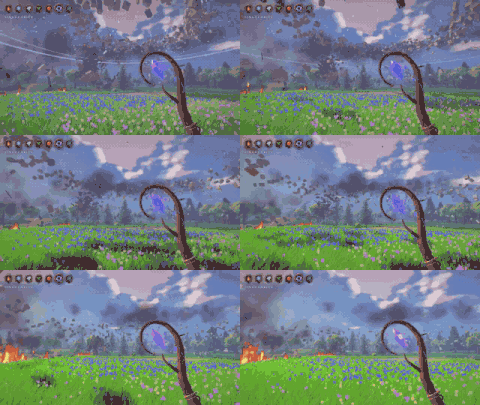
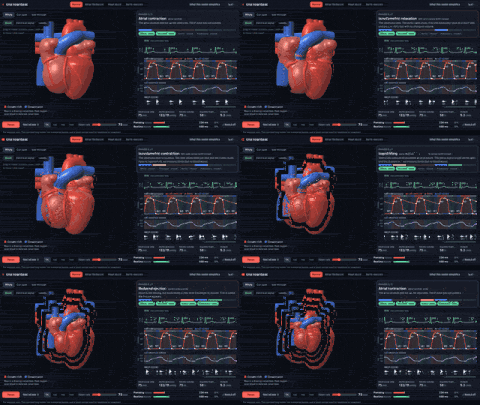
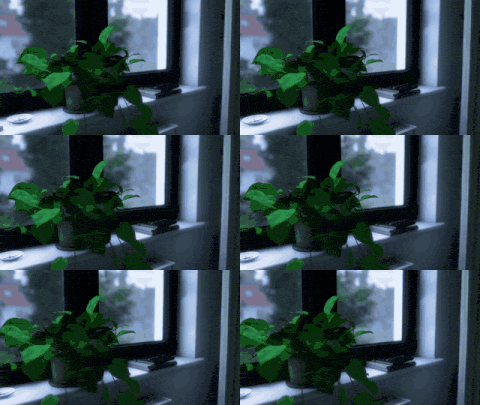
Three different kinds of finish: a playable physics sandbox, an inspectable medical explainer and a code-only interior. Each is linked to its creator's original.
The pattern behind the useful demos
The launch wall is full of games, but the interesting projects are not all games. They are artifacts with a small enough surface that the model can finish the job. The creator gives the model a world, a mechanic, a scientific question or a tool boundary. The model returns something a reader can open in a browser and judge in under a minute.
That is why "build me an app" is a weak prompt and "build one room in which the only interaction is opening a curtain, and prove that the light changes" is stronger. The second request has a state, an action and a visible result. It also gives the model a stopping condition: once the curtain moves and the room responds, the job is done.
The eight recipes at a glance
| Recipe | Real example | Start at | The check |
|---|---|---|---|
| Start with a world you can cross Browser game · one interaction | Starry Nightrider ↗ | Draft at High. | A new player can move within five seconds without reading instructions. |
| Turn one law into a toy Simulation · visible cause and effect | Small Magic ↗ | High is enough for a single stable system. | Changing a control produces a visible change before the reader has to guess. |
| Make a scientific claim inspectable Explainer · view, source, test | One Heartbeat ↗ | Use High for the first complete pass. | The same input updates every view, so the diagram cannot disagree with the chart. |
| Reconstruct from sources, not vibes Research · citations inside the artifact | Ancient Babylon, 600 BC ↗ | Start at High with a small source set. | A reader can move from any major visual element back to its source note. |
| Replace a search detour Utility · one job, no account | RoverKit ↗ | High is a sensible default. | The first useful action is available without sign-up, configuration or an API key. |
| Give sound a visible system Audio · generate, inspect, mute | House Bangers ↗ | Use High for the first playable loop. | Every generated sound has a visible control that changes it. |
| Constrain the asset budget Visual · code is the material | Room at Dawn ↗ | High for a single scene. | The repository contains no hidden image, model or audio asset that carries the effect. |
| Put the agent inside the tool Systems · a command surface | PULP ↗ | Start at High and keep the command surface narrow. | The human interface and the agent commands use the same underlying actions. |
The recipes
Browser game · one interaction
Start with a world you can cross
Starter prompt
Build a single-page browser game in one HTML file. The theme is [world]. Give the player one clear objective, one movement verb and one risk. Make the first playable state obvious without a tutorial. Use generated geometry, colour and sound only; do not import images, models or audio. Add a restart button and a short end state. Keep the world small enough that every visible edge is intentional.
Acceptance checks
- A new player can move within five seconds without reading instructions.
- The objective, failure state and restart path are visible in the interface.
- The game still runs after a browser refresh and does not depend on a server.
Simulation · visible cause and effect
Turn one law into a toy
Starter prompt
Build an interactive simulation of [one physical idea]. Put the important variables on screen and make each one change the result in a way a reader can see within one second. Include a reset, a pause and a small set of presets. Keep the simulation deterministic when the random seed is fixed. Add a one-paragraph explanation of the approximation and one check that fails loudly when the simulation leaves its intended range.
Acceptance checks
- Changing a control produces a visible change before the reader has to guess.
- The reset restores the same initial state, including the random seed.
- The page states what is simulated and what is only decorative.
Explainer · view, source, test
Make a scientific claim inspectable
Starter prompt
Build an educational explainer for [mechanism]. Use one shared dataset for the diagram, the chart and the text summary. Put units on every number, label the normal case and one failure case, and show the source for each factual claim. Add a short test script that checks the chart values against the source data. Do not generate decorative data: if a value is unknown, show an empty state.
Acceptance checks
- The same input updates every view, so the diagram cannot disagree with the chart.
- Every quantitative label has a unit, a date and a source.
- The page includes a visible limitations section and a way to inspect the raw values.
Research · citations inside the artifact
Reconstruct from sources, not vibes
Starter prompt
Reconstruct [place, event or syllabus] from at least five public sources. Build a reading interface or explorable scene, but keep a source drawer beside it. For every reconstructed element, record the source and mark whether it is documented, inferred or decorative. When the sources disagree, show the disagreement instead of choosing silently. End with a page that lists what is known, what is uncertain and what was left out.
Acceptance checks
- A reader can move from any major visual element back to its source note.
- Documented, inferred and decorative material use different labels.
- The reconstruction still makes sense when the source drawer is open.
Utility · one job, no account
Replace a search detour
Starter prompt
Build a local-first browser utility for [specific job]. It must work without an account and without sending user input to a server. Put the privacy boundary in the interface, not only in a footer. Give the user one obvious starting action, a useful empty state and a way to export or reset their work. If the browser cannot support the feature, explain the fallback instead of failing silently.
Acceptance checks
- The first useful action is available without sign-up, configuration or an API key.
- The page says exactly what stays on the device and what leaves it.
- A refresh or unsupported browser produces a readable state rather than a blank canvas.
Audio · generate, inspect, mute
Give sound a visible system
Starter prompt
Build a browser audio toy for [genre or instrument]. Generate a short loop from a small set of musical rules, show the pattern or waveform while it plays, and provide tempo, key, instrument and mute controls. Start muted and require one click to play. Put a visible stop button and an export or record action. Do not autoplay, and do not hide the generation rules behind a single magic button.
Acceptance checks
- Every generated sound has a visible control that changes it.
- The page never starts audio before a user gesture.
- A reader can stop, reset and reproduce the same pattern.
Visual · code is the material
Constrain the asset budget
Starter prompt
Build [scene or visual study] using only HTML, CSS and JavaScript. Do not use imported images, 3D models, textures, fonts-as-images or audio files. Generate every visible surface and sound in code. Put a small performance readout in the corner and make the scene usable on a laptop without a discrete GPU. Explain which visual effects are approximations and provide a low-quality toggle.
Acceptance checks
- The repository contains no hidden image, model or audio asset that carries the effect.
- The scene has a stable frame rate on a normal laptop and a visible low-quality mode.
- The page explains the rendering trick in text, and the source matches that explanation.
Systems · a command surface
Put the agent inside the tool
Starter prompt
Build a small desktop-like tool for [job] with a documented command surface. Every action available to a person must also be available as a typed command with the same validation. Add dry-run, undo and an event log. The agent should operate the tool through that surface instead of bypassing it with hidden state. Include a sample session that starts from an empty workspace and reaches a useful result.
Acceptance checks
- The human interface and the agent commands use the same underlying actions.
- Dry-run shows the planned change before it is applied, and undo restores the previous state.
- The event log is enough to replay a short session without guessing.
What to add after the first result
A second prompt should repair a failing check, not add decoration. If the game opens but the player cannot tell what to do, ask for a visible objective and a first-frame signpost. If the explainer draws a chart but the numbers do not match the source, ask for one shared data object and a failing test before changing the colours. If the local tool works but leaks a request, ask for the network boundary and an offline fallback before adding another feature.
This is where effort levels become useful. A layout change belongs at Medium. A state-machine rewrite after a failed collision test belongs at Xhigh. Max is for an unattended run in which the model has to perform the same audit repeatedly, not for making a nicer gradient.
What this page cannot tell you
These are prompt shapes inferred from completed projects, not a controlled comparison of Fable against another model. A recipe can guide a first attempt; it cannot tell you how often the attempt will pass on your task, how many tokens it will spend, or whether the result is novel. The linked projects are the evidence that this kind of artifact has been built, not proof that the exact prompt will reproduce it.
Cost is especially context-dependent. Fable's standard rate is $8 per million input tokens and $40 per million output tokens, but effort changes how many reasoning tokens a run spends. Before turning a recipe into a batch job, read the effort and cost guide and measure one representative request at two settings.
Questions people ask
Are these the prompts the creators used?
No. The prompts on this page are starter templates written for this guide. Each recipe links to real launch-week projects so you can inspect the result, but the creators' original prompts are not implied unless a project explicitly publishes one.
What can Claude Fable 5.2 build from a prompt?
The launch-week examples include browser games, 3D scenes, scientific visualisations, local utilities, audio generators, source-grounded reconstructions and systems experiments. The common thread is not a genre. It is a bounded artifact with a clear interaction, a visible failure state and enough source or runtime evidence for another person to inspect.
Which effort level should I use for a first build?
Start at High for API work and Medium in the Claude apps or Claude Code. Move to Xhigh when a complete attempt fails because the model needs to reconsider the architecture, not because a button is in the wrong place. Use Max only for a long unattended job where one strong result is worth the wait and the token bill.
How do I stop the result from being another generic demo?
Choose an artifact that can be checked. A game needs a playable loop; a scientific explainer needs units and sources; a local utility needs a privacy boundary; an audio toy needs a stop button and reproducible controls. Write those checks into the prompt before asking for visual polish.
Can I reuse these recipes commercially?
The prompt text is a starting point, not a licence to reuse another creator's project, artwork, name or code. Check each linked project's repository and licence first. The demo wall links to the original work for exactly that reason; this page does not package those assets.
Browse all 45 demos Choose an effort level Read the full reference