Practical guide · verified 2026-11-13
Medium, High, Xhigh or Max: what Fable 5.2's effort dial actually changes
Fable 5.2's effort setting is the difference between a model that feels expensive and one that looks absurd. At Medium, Anthropic shows it matching Opus 5.5's top score on some tasks for a fraction of the cost. At Max, Artificial Analysis measured 46.8 minutes and $26.54 for one benchmark task. The model did not change. The thinking budget did.
Launch and model card read 2026-11-13 Anthropic's model card →
What each effort level is for
| Field | Value |
|---|---|
| Levels | Low · Medium · High · Xhigh · Max OpenRouter lists all five as supported reasoning efforts. |
| API default | High Anthropic's model card for Fable 5.2. |
| Apps and Claude Code | Medium Anthropic's launch post calls Medium the default there. |
| Thinking mode | Adaptive, always on Effort controls depth; thinking cannot be turned off. |
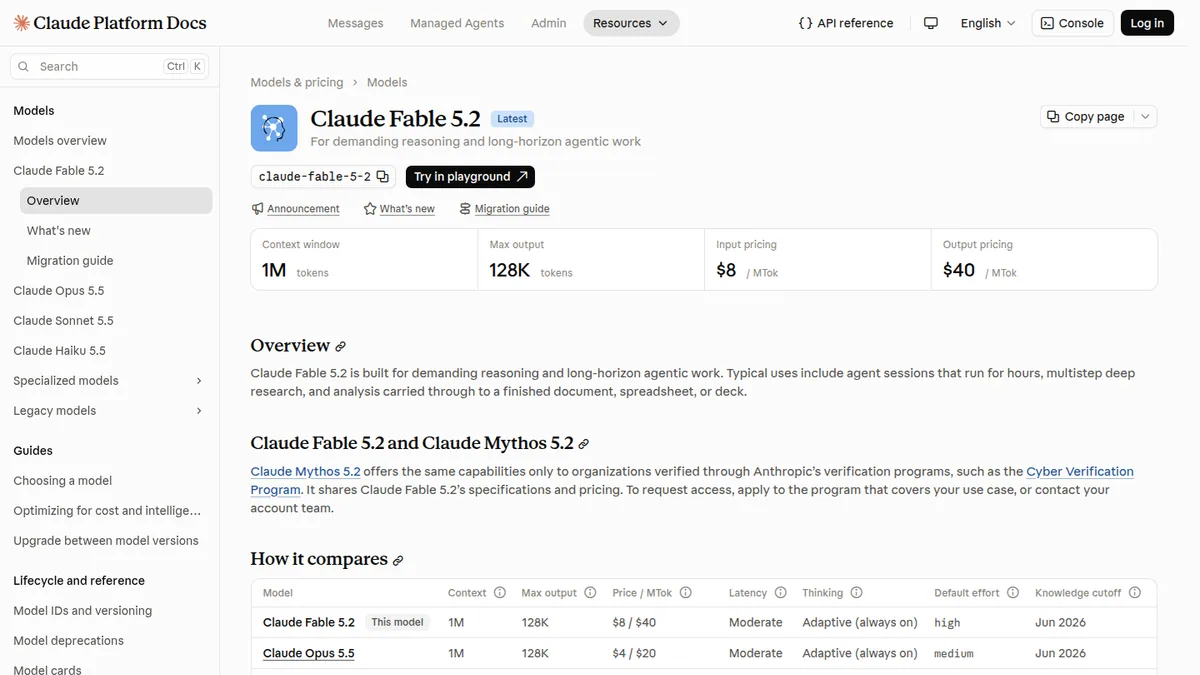
| Base price | $8 in / $40 out per million The per-token rate does not change with effort. |
| Fast mode | $16 in / $80 out per million Up to 2.5x faster generation at double the token price. |
platform.claude.com/docs/en/models/fable-5-2/overview; anthropic.com/claude-fable-and-mythos-5-2 Verified 2026-11-13 OpenRouter catalogue reasoning metadata Anthropic describes thinking as adaptive and always on. Effort is not a switch that turns reasoning on and off; it sets how deep the model is allowed to go. A low setting can be surprisingly good on a task with a clear answer because there is little to explore. A high setting can spend minutes following branches that a person would never check. The right setting is a property of the job, not a badge of how much you care about quality.
| Level | Use it for | Do not use it for | Published evidence |
|---|---|---|---|
| Low | A bounded question whose answer is easy to check | Long-horizon work where a missed branch is expensive | Anthropic says Low matches Opus 5.5's top HLE score for less than one-tenth of the cost per task. |
| Medium | Interactive coding, everyday research, app and Claude Code work | A task that has already defeated a cheaper attempt | Anthropic shows Medium matching Opus 5.5's top WANDR score at about 40% of the cost per task. |
| High | API defaults, long agent sessions, large code changes | A task where a measured Medium run is already good enough | Anthropic says High scored level with Opus 5.5 at Max on FrontierCode 2.0 for about half the cost per task. |
| Xhigh | The hardest coding and research attempts; unattended work where quality matters | Chat, quick edits or anything you need back in under a minute | This is the setting behind Fable's 49.1% FrontierCode headline. |
| Max | Benchmarking, deliberate one-off investigations, long batch jobs | A default setting, a user-facing request, or a cost-sensitive loop | Artificial Analysis measured 46.8 minutes and $26.54 per task at Max. |
Anthropic's launch post and model card, read 2026-11-13 No private latency test exists for the model on this page
The arithmetic behind the bill
The list price is easy to quote and easy to misread. A million input tokens costs $8 and a million output tokens costs $40 at the standard rate. A request that spends most of its budget on reasoning can therefore be much more expensive than its visible prompt suggests. The examples below use only the published rates and exclude cache discounts, tools and provider fees.
| One request or batch | Standard | Fast mode | What it represents |
|---|---|---|---|
| 100K input + 20K output | $1.60 | $3.20 | A single long prompt with a moderate answer |
| 1M input + 100K output | $12.00 | $24.00 | A large repository or document set in one call |
| 10M input + 1M output | $120.00 | $240.00 | A multi-call agent run; cache hits can lower the real input bill |
| Batch API equivalent | half price | n/a | Anthropic lists 50% off input and output for Batch API |
Calculated from Anthropic's published rates, read 2026-11-13 Reasoning-token volume is the missing variable; the table does not estimate it
Why Max can cost $26 and why that is still useful
Artificial Analysis placed Fable 5.2 first on its Intelligence Index, with a score of 64.6 out of 78 models. That result came from running the model at Max. The same run recorded 267.23 seconds to the first answer token, 97.48 output tokens per second, 46.8 minutes per task and an average cost of $26.54 per task.
Those numbers are not an argument against Fable. They are an argument against leaving Max on by accident. A model that will spend tens of minutes on a hard task is valuable when the task is worth it. The same behaviour is a poor fit for a chat box, a code-completion path or a high-volume classifier. The effort number turns one model into several products with very different cost profiles.
What fast mode changes
Fast mode is not a discount or a cheaper effort setting. It is a speed purchase: Anthropic says token generation can be up to 2.5 times faster, and the token rates double to $16 input and $80 output. It is available through the Claude API and supported cloud platforms. The trade is easy to state and hard to price without your own data: measure the end-to-end time a user actually waits, including tool calls and queueing, before assuming that a faster generator fixes the experience.
A practical settings policy
- Interactive product work: try Medium first. Keep High as the fallback if the task crosses more than one file or needs a long tool loop.
- API agents: set High explicitly. Do not rely on a client default that may change between surfaces.
- Long unattended migration or review: use High for the first pass, Xhigh for a failed case, and Max only when nobody is waiting and the output is expensive to reproduce.
- High-volume classification: use a cheaper model. Fable's base rate is too high for routine routing even at Low.
- Fast mode: buy it only after measuring a user-visible latency gain that is worth the doubled token rate.
What this page cannot tell you
Anthropic does not publish a per-effort latency table, and the independent benchmark only covers Max. The exact number of thinking tokens a setting will spend depends on the prompt, the tools and the model's own stopping decision. Use these levels as a shortlist, then run the same representative task at two settings and compare pass rate, wall time and total token charges. The best setting for a coding agent is not automatically the best setting for a research agent, even when the underlying model is the same.
Questions people ask
Does a higher effort level cost more per token?
No. The published input and output prices stay at $8 and $40 per million. Effort changes how many reasoning tokens the model spends, so the same request can consume very different numbers of tokens at Medium and Max. That is why the cost per task moves even though the rate card does not.
What is the default effort for Claude Fable 5.2?
The API model card lists High as the default. Anthropic's launch post separately describes Medium as the default in Claude apps and Claude Code. If your application needs a predictable setting, pass the effort explicitly rather than relying on a client default.
Should I use Max for difficult coding tasks?
Usually no. Start with High. Anthropic says Fable at High was roughly level with Opus 5.5 at Max on FrontierCode 2.0 for about half the cost per task, and Xhigh produced the highest published FrontierCode score. Max is for the rare job where the extra reasoning is worth a long wait and a multi-dollar bill.
When is fast mode worth double the token price?
When a person is waiting and the time saved changes the product. Fast mode can generate tokens up to 2.5 times faster, but it doubles the rates to $16 input and $80 output. For an overnight batch, the standard rate is usually the better purchase. Measure the end-to-end latency in your own harness before switching.
Why did Artificial Analysis report $26.54 per task?
Artificial Analysis runs the public model at Max effort on a fixed intelligence benchmark. The model uses a large number of reasoning and output tokens on those tasks, and the per-task cost includes the resulting input and output charges. It is a useful worst-case calibration point, not the price of a normal chat turn.
What can I measure myself before choosing a setting?
Run the same representative task at Medium, High and Xhigh. Record whether the answer passes your check, the wall-clock time, and the total input, cache-read and output tokens. The setting that clears your quality bar at the lowest all-in cost is the right default; the more expensive tier is an escalation path, not the starting point.