Model reference · verified 2026-11-13
MiniMax H3-Image, specified
MiniMax H3-Image is a 33.1B-parameter diffusion transformer built from the H3 stack. It combines text-to-image and reference-based editing in one checkpoint, generates roughly 16 megapixels without an upscaler, and runs in six sampling steps without classifier-free guidance. This page is the part a model card makes you assemble yourself: the file sizes, the API limits, the per-image bill and the licence boundaries.
Launch post 2026-11-11 Read 2026-11-13 Hugging Face model card →
The specification
| Field | Value |
|---|---|
| Model | MiniMax-H3-Image Highspeed variant: MiniMax-H3-Image-Highspeed. Same parameters and limits. |
| Released | 2026-11-11 Weights, launch post and API documentation published together. |
| Architecture | Dense single-stream DiT 33.1B parameters, 50 layers, hidden size 5,376, 56 attention heads. |
| Text encoder | Qwen3-VL, unchanged The full MiniMax-H3 text encoder; the DiT reads hidden states from layer 50. |
| Image VAE | CNN encoder + 24-layer ViT decoder 16× spatial downsampling and 24 latent channels. |
| Sampling | 6 steps · no CFG The local API rejects other step counts and guidance scales. |
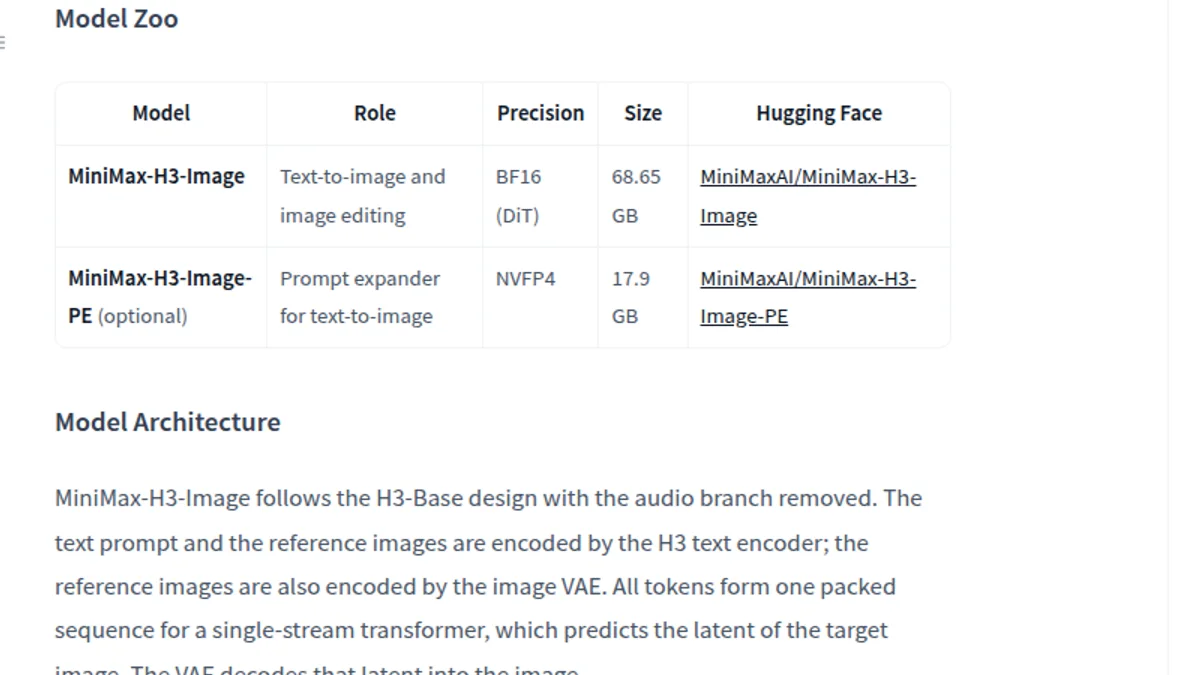
| Weights | 68.65 GB BF16 Plus a separate 66.7 GB H3 text encoder. |
| Optional prompt expander | 17.9 GB NVFP4 MiniMax-H3-Image-PE for local text-to-image prompt expansion. |
| Licence | MiniMax-H3-Image Community License Agreement Open weights, not an OSI open-source licence. |
huggingface.co/MiniMaxAI/MiniMax-H3-Image; minimax.io/blog/minimax-h3-image Verified 2026-11-13 Architecture, model files and sampling limits: model cardRelease date, API and pricing: MiniMax launch post and platform docs Where the parameters sit
H3-Image is H3-Base with the audio branch removed. The text prompt and any reference images are encoded by the H3 text encoder; reference images also pass through the image VAE. Those tokens are packed into one sequence for a single-stream transformer, which predicts the latent for the target image. The VAE then decodes that latent.
The important number for a local operator is not only the 33.1B DiT. The text encoder is the full Qwen3-VL encoder from H3 and is a separate 66.7 GB download. The repository's own transformer folder is 66.28 GB, plus 2.34 GB for the VAE and small tokenizer and processor files. A complete local build starts around 135 GB before runtime state, and the optional prompt expander adds 17.9 GB.
Output sizes and the 16 MP target
The model is trained to work across roughly 4–20 megapixels and is at its best near 16 MP. The API exposes either a fixed width and height or an aspect ratio plus a 1K, 2K or 4K area preset. The 4K preset does not mean a square image every time: at 16:9 it returns 5472×3072, and at 21:9 it returns 6272×2688.
| Aspect ratio | Common 16 MP output |
|---|---|
| 1:1 | 4096×4096 |
| 4:3 / 3:4 | 4736×3552 / 3552×4736 |
| 3:2 / 2:3 | 5024×3360 / 3360×5024 |
| 16:9 / 9:16 | 5472×3072 / 3072×5472 |
| 21:9 | 6272×2688 |
Model card and API output-size tables, read 2026-11-13 Custom sizes are never rounded; out-of-range values return HTTP 400
API limits that affect product design
| Field | Value |
|---|---|
| Prompt length | 32,000 characters With enhancement disabled, only roughly the first 4,096 tokens take effect. |
| Images per request | 1–10 Default is one. |
| Reference images | 1–16 JPEG, PNG, WEBP, HEIC or HEIF. |
| Request body | 64 MiB Base64 inflates the original file by about one third. |
| Output area | 655,360–20,000,000 px The server never scales or rounds a custom width and height. |
| Aspect ratio | 1:3 to 3:1 Applies to both the preset and custom-size routes. |
| Output formats | JPEG, PNG, WEBP JPEG is the default. |
| Not supported | Masks, transparency, previews The API rejects these editing options. |
The prompt number is the one most likely to surprise a builder. The API accepts up to 32,000 characters, but with prompt enhancement disabled only about 4,096 tokens of the prompt take effect. The local model card says the same thing in its own words. If a prompt is long because it carries layout instructions, measure the revised prompt that the API returns rather than assuming every character reached the model.
The 64 MiB request body is another real ceiling. Base64-encoded references inflate the original file, so sixteen large images can exceed the limit before the reference count does. Public URLs and uploaded file IDs avoid that multiplication; the API supports both.
Pricing: token rates and actual task examples
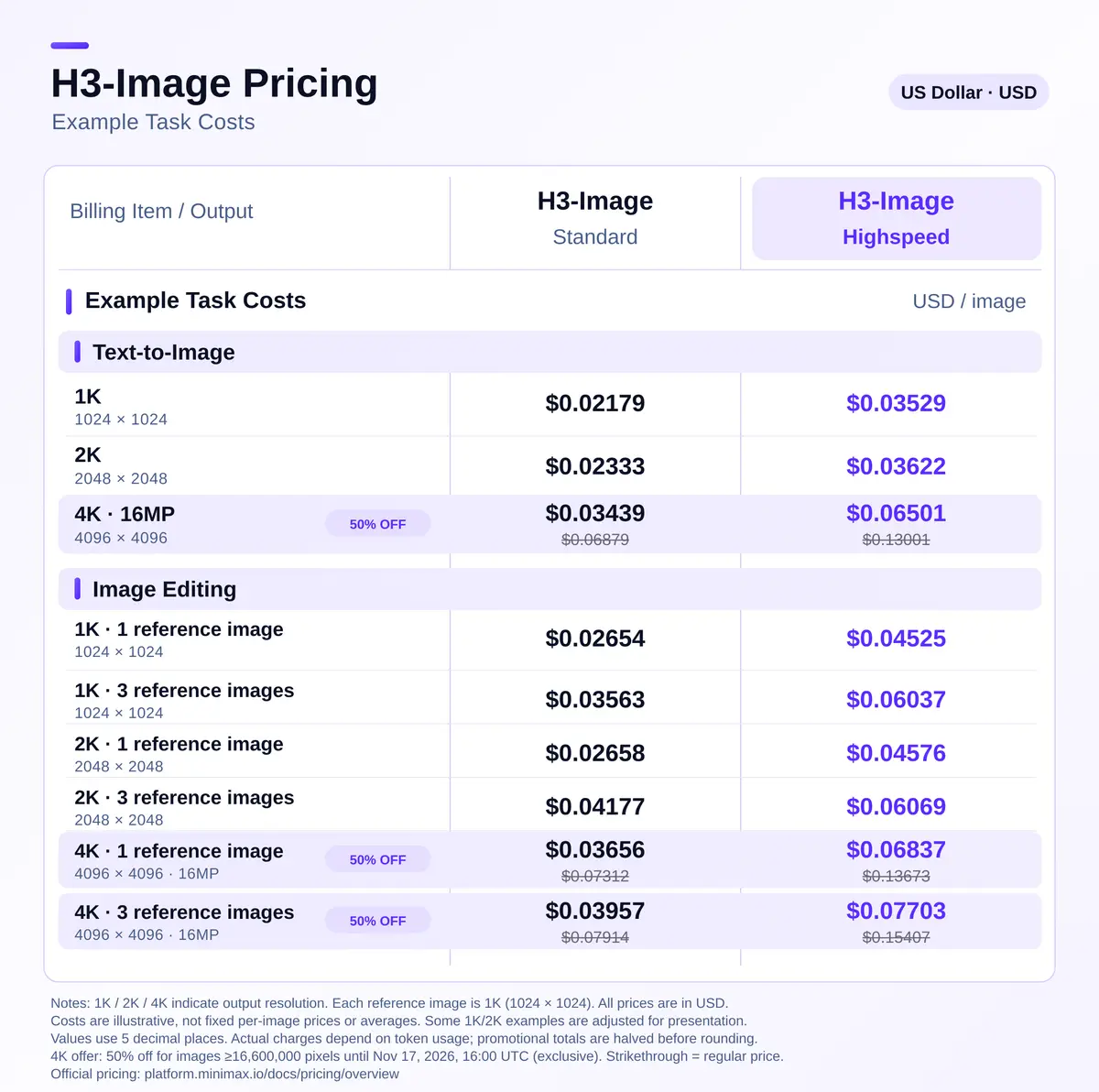
MiniMax bills image generation by tokens rather than by a flat per-image price. The table below gives the three rates that matter. The example costs are more useful for planning: they show that 4K is not ten times the price of 1K, and that adding references costs less than moving from Standard to Highspeed.
| Model | Text input /M | Image input /M | Image output /M |
|---|---|---|---|
| MiniMax-H3-Image Standard | $2.30 | $1.50 | $3.80 |
| MiniMax-H3-Image-Highspeed Highspeed | $2.30 | $3.00 | $7.60 |
| Example task | Output | Standard | Highspeed |
|---|---|---|---|
| Text to image | 1K · 1024×1024 | $0.02179 | $0.03529 |
| Text to image | 2K · 2048×2048 | $0.02333 | $0.03622 |
| Text to image | 4K · 4096×4096 | $0.03439 launch · $0.06879 regular | $0.06501 launch · $0.13001 regular |
| Image edit · 1 reference | 1K | $0.02654 | $0.04525 |
| Image edit · 3 references | 1K | $0.03563 | $0.06037 |
| Image edit · 1 reference | 4K | $0.03656 launch · $0.07312 regular | $0.06837 launch · $0.13673 regular |
| Image edit · 3 references | 4K | $0.03957 launch · $0.07914 regular | $0.07703 launch · $0.15407 regular |
MiniMax pricing overview, read 2026-11-13 Launch discount ends 17 November 2026, 16:00 UTC Official pricing →
The licence is the largest constraint
The phrase “open weights” is accurate; “open source” is not. The MiniMax-H3-Image Community License Agreement grants a royalty-free licence only in the Applicable Territory, which excludes the European Union, the United Kingdom, South Korea and the United States. Hosted services and organisations above $1 million in annualised revenue need separate written authorisation. A commercial product must display the model name in its user interface.
| Field | Value |
|---|---|
| Licence | MiniMax-H3-Image Community License Agreement The model card links the agreement as LICENSE; it is not Apache-2.0 or MIT. |
| Applicable territory | Worldwide minus four markets The EU, UK, South Korea and the United States are excluded from the weights licence. |
| Hosted service | Separate authorisation Required before providing H3-Image or a derivative through an API or hosted product. |
| Revenue threshold | $1M annualised A licensee above the threshold also needs separate written authorisation. |
| Outputs | MiniMax claims no rights The user is responsible for the output and its downstream use. |
| Commercial marking | Name required A commercial product using the model must display “MiniMax-H3-Image” in its UI. |
Licence and acceptable-use policy read 2026-11-13 Licence text →
The hosted MiniMax API is a separate offering. A reader in an excluded market should not infer from an API account that the downloadable weights are licensed for local use there. That distinction belongs before the hardware decision, not after it.
Primary sources
- Hugging Face model card and files — architecture, model zoo, download commands and local frameworks.
- MiniMax-H3-Image-PE — the optional local prompt expander.
- Image generation API guide — endpoints, size rules, prompt enhancement and failure handling.
- Pricing overview — token rates and the current launch promotion.
- Community licence — territory, hosted-service and commercial terms.