Head to head · verified 2026-11-13
Claude Fable 5.2 vs Opus 5.5: the same window, twice the price
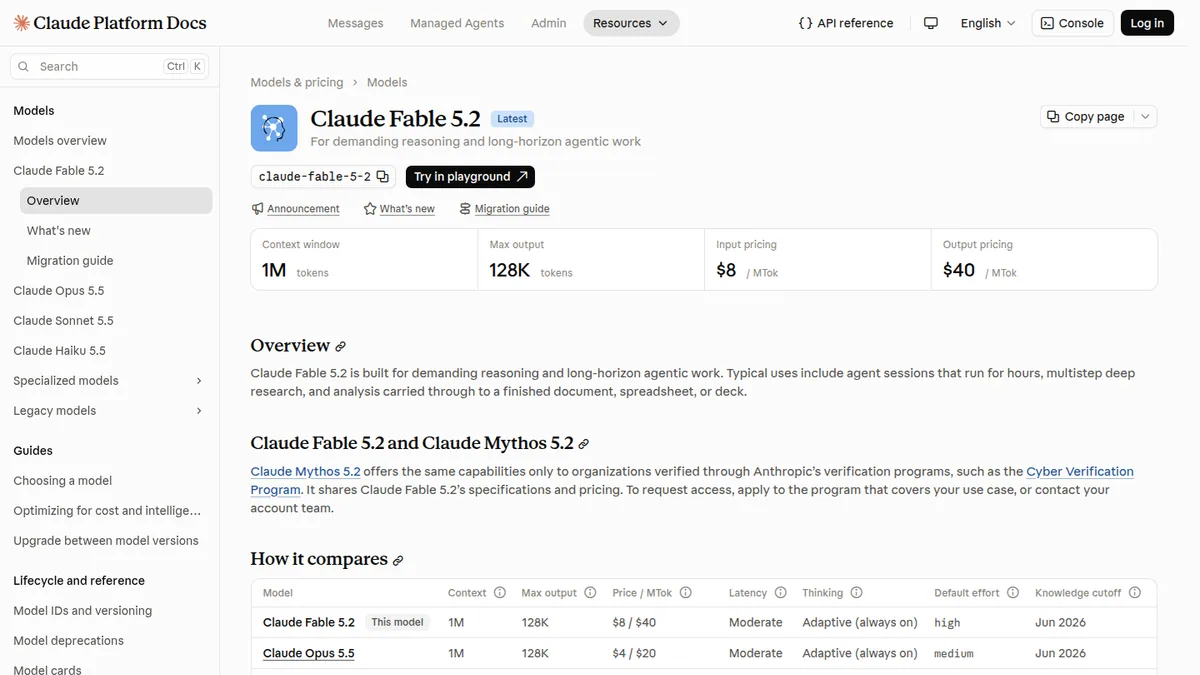
Anthropic built two models with the same 1M-token window and the same 128K output ceiling, then priced one at twice the other. Fable 5.2 is the frontier attempt. Opus 5.5 is the daily driver. The hard part is not the spec table; it is knowing when a task has earned the upgrade.
OpenRouter and Anthropic model cards read 2026-11-13 Fable 5.2 docs → Opus 5.5 page →
The same capacity, a different price
| Field | Claude Fable 5.2 | Claude Opus 5.5 |
|---|---|---|
| Maker | Anthropic | Anthropic |
| OpenRouter id | anthropic/claude-fable-5.2 | anthropic/claude-opus-5.5 |
| Context | 1,000,000 tokens | 1,000,000 tokens |
| Max output | 128,000 tokens | 128,000 tokens |
| Input / output | $8 / $40 per million | $4 / $20 per million |
| Cache read | $0.20 per million | $0.20 per million |
| Default effort | High on the API; Medium in apps and Claude Code | Medium |
| Positioning | The hardest, longest-running work | The strongest daily driver |
OpenRouter catalogue read 2026-11-13 Anthropic model cards for default effort and positioning
Where Fable earns the premium
The launch table puts Fable above Opus on most of the tasks Anthropic selected. The largest gaps are on agentic coding, robotics, scientific research and chart recognition. Some of those rows use different effort levels, so read the score and the setting together. The useful question is not “who won the table?” but “does this row resemble my work?”
| Benchmark | Fable 5.2 | Opus 5.5 | What it suggests |
|---|---|---|---|
| FrontierCode 2.0 · Agentic coding | 49.1% · Xhigh | 45.5% | Anthropic's own comparison; not a harness we ran. |
| FrontierSWE v2 · Agentic coding | 69.9% | 62.3% | Anthropic's own comparison; not a harness we ran. |
| AutomationBench · Business workflows | 51.4% | 42.5% | Anthropic's own comparison; not a harness we ran. |
| RoboDojo Sim · Robotics | 64.9% | 39.4% | Anthropic's own comparison; not a harness we ran. |
| AA-Briefcase v1.1 · Knowledge work | 66.1% · 1,785 Elo | 61.2% · 1,800 Elo | The rubric score and Elo disagree; do not read one as a clean win. |
| Humanity's Last Exam · with tools · Reasoning | 74.2% | 67.7% | Anthropic's own comparison; not a harness we ran. |
| Chartography · no tools · Visual recognition | 73.4% | 64.4% | Anthropic's own comparison; not a harness we ran. |
Anthropic's launch table, read 2026-11-13 Higher effort or vendor-selected tasks can change the comparison
What the 2x looks like on a bill
The rate card is simple until the model starts spending reasoning tokens. The estimates below use list prices only. They are useful for the shape of the decision, not as a quote for your production workload.
| Workload | Fable 5.2 | Opus 5.5 | Why |
|---|---|---|---|
| One long request 100K input + 20K output | $1.60 | $0.80 | The same task at list rates; Fable is exactly 2x. |
| A million-token batch 5M input + 1M output | $80 | $40 | Still 2x, before cache reads or batch discounts. |
| Cache-heavy agent 10M cached input + 1M output | $42 | $22 | Both charge $0.20 per million cached reads; output price drives the gap. |
Anthropic's published rates, read 2026-11-13 Excludes effort-dependent reasoning tokens, tools and provider surcharges
Choose Fable 5.2 when
One careful attempt is worth more than several cheap ones
- The task is an open-ended migration, a long agent session or a hard research question.
- The output is reviewed by a person whose time costs more than the token premium.
- A Medium or High Opus run has already missed the thing you needed.
- You are using it as an advisor or orchestrator for cheaper subagents.
Stay with Opus 5.5 when
The work is hard but the task is already well defined
- You are fixing a feature, reviewing a diff or making a bounded change in a known codebase.
- The product path handles many requests and the default needs to be economical.
- You have not measured a quality gain that survives the 2x token price.
- The job is chat, extraction or a short tool call rather than a long-horizon attempt.
A rule that survives the launch week
Use the cheapest model that clears your evaluation, then spend the difference on more attempts, better tests or a human review. Fable is valuable because it occasionally does something the cheaper tiers cannot, not because it should run every call. Anthropic's own recommendation points the same way: start on Opus, then switch upward or downward as the scope and complexity require.
What this comparison cannot tell you
Benchmark rows are selected by the vendor, several use different effort settings, and the independent $26.54 task cost is a Max-effort measurement rather than a general API forecast. Neither model has been tested here on a private workload. The only reliable answer is an A/B on your own tasks: run the same prompt at Opus Medium, Fable High and, for the hard failures, Fable Xhigh. Compare pass rate, wall time and total token charges. The model with the better headline is not necessarily the model with the better bill.
Questions people ask
Is Fable 5.2 better than Opus 5.5?
On Anthropic's launch table, Fable scores higher on most capabilities, and its Xhigh FrontierCode result is the company's highest released score. That does not make it the better default. Opus has the same 1M-token window and 128K output at half the price, and Anthropic recommends starting most coding and knowledge work there. Fable is the escalation tier for work that needs more reasoning.
Do Fable 5.2 and Opus 5.5 have the same context window?
Yes. Both list a 1,000,000-token context window and a 128,000-token maximum output on OpenRouter and in Anthropic's model card. Capacity is not the reason to pay the Fable premium.
How much more expensive is Fable 5.2 than Opus 5.5?
Fable lists at $8 per million input tokens and $40 per million output tokens. Opus lists at $4 and $20. Cache reads are $0.20 per million for both. The Fable premium is therefore exactly 2x on fresh input and output before effort-dependent token use changes the actual bill.
What effort should I use on Fable 5.2?
Start at High for API work and Medium in Claude apps or Claude Code if that is the client default. Anthropic says High scored about level with Opus 5.5 at Max on FrontierCode 2.0 for roughly half the cost per task. Xhigh produced the 49.1% headline; Max is for benchmarks and long unattended jobs.
Should I use Fable 5.2 for routine coding?
Usually no. Routine feature work, reviewable diffs and bug fixes are the jobs Opus 5.5 is positioned for. Fable becomes interesting when the task is large, ambiguous or has already defeated a cheaper attempt. Keeping Fable as an escalation path is usually cheaper and easier to operate.
What about Sonnet 5.5?
Sonnet 5.5 costs $2 / $10 per million and has the same headline 1M context and 128K output. It is the balanced tier for well-scoped product work and high-volume coding. The three-model hierarchy is simple: Sonnet for routine, Opus for hard daily work, Fable for the jobs that need a frontier attempt.
What is Fable's fast mode?
Fast mode generates tokens up to 2.5 times faster, according to Anthropic, and costs $16 input / $80 output per million. It doubles the token rate. It is a latency purchase, not an effort setting and not a discount.
Where can I use both models?
Both are available through Anthropic's API and OpenRouter. The OpenRouter ids are anthropic/claude-fable-5.2 and anthropic/claude-opus-5.5. Check the current catalogue before production because prices and availability can change.
How effort changes the bill Fable's full reference What people built