HunterAlphaHub
OpenRouter model reference Facts from the public catalogue, dated and labelled
Jev Laya Fable 5.2 Verified
2026-11-13

Model topic · verified 2026-11-13

MiniMax H3-Image, and the 10-second 4K claim

Short answer

MiniMax released H3-Image on 2026-11-11: one open-weight checkpoint for text-to-image and reference-based editing, with up to 16 reference images and roughly 16-megapixel output. The speed story is real, but the more important details are the published P50, the roughly 135 GB local download and a community licence that does not cover the US, UK, EU or South Korea.

Released 2026-11-11 MiniMax launch → Weights on Hugging Face →

  • 16 MP native output 4096×4096 through 6272×2688
  • 16 reference images one editing prompt can combine them
  • 33.1B DiT parameters dense, 50 layers, six sampling steps
  • $0.034 launch price · 4K Standard text-to-image until Nov 17
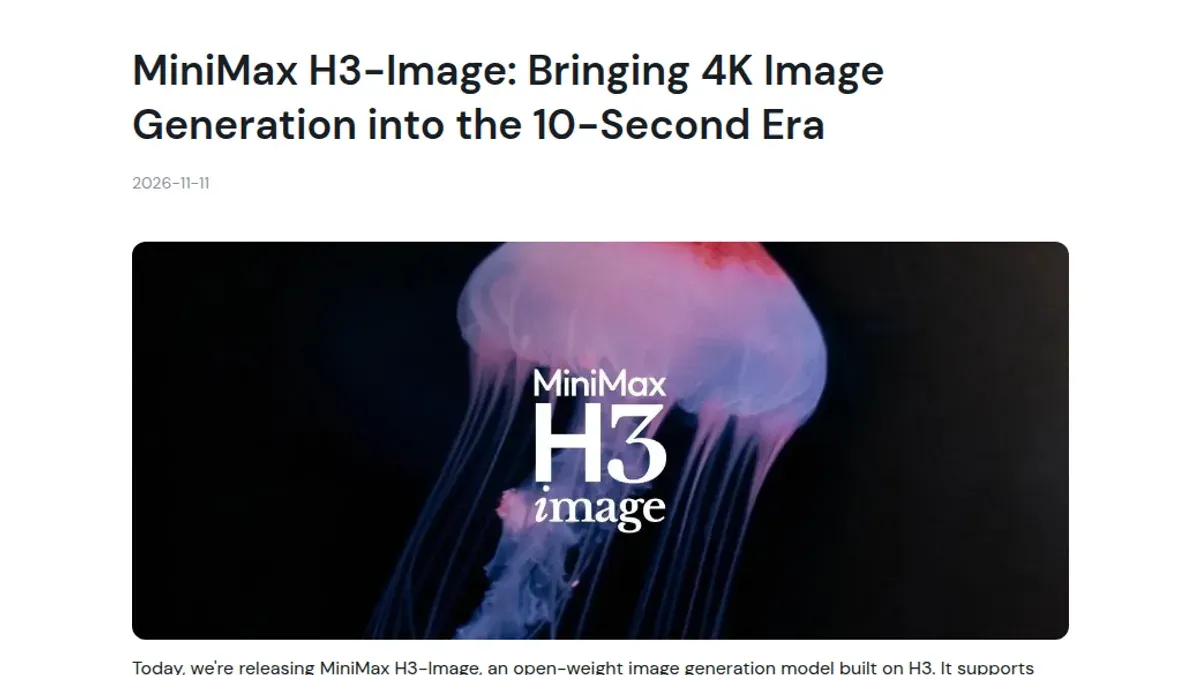
MiniMax · launch post MiniMax's H3-Image launch post, showing the model name, the 11 November 2026 date and the official H3 Image cover
The launch post names the model and the 4K promise MiniMax, captured 2026-11-13; the cover is the company's own image Read the launch post →

The short version

One model, two jobs

The same checkpoint handles a prompt with no references and an edit with one to sixteen references. That matters for tool builders: a compositor, a product-shot editor and a text-to-image box can share the model and the prompt-enhancement path.

The chart is slower than the headline

MiniMax's launch post says 4K takes under ten seconds. Its published latency chart puts 4K text-to-image at 16.0 seconds P50 on Standard and 10.3 seconds on Highspeed. The model is fast, but the chart is the number to put in a capacity plan.

The API and the weights are different products

The hosted API has a per-image and per-token bill. The weights are a roughly 135 GB download with an extra licence attached. A reader in the US, UK, EU or South Korea can evaluate the API without treating the community weights as licensed for local use there.

Open weights, not open source

The model card uses the phrase open-source in its prose, but the actual licence is the MiniMax-H3-Image Community License Agreement. It excludes four major territories and requires separate authorisation for hosted services or firms above $1 million in annualised revenue.

The launch, in one table

FieldValue
Released
2026-11-11
MiniMax launch post and Hugging Face model card.
Model type
Open-weight image generator and editor
Built on MiniMax H3; MiniMax-H3-Image Community License Agreement, not an OSI licence.
One checkpoint
Text to image + image editing
No separate editing model; references are passed to the same endpoint family.
Reference images
Up to 16
Upload order becomes Picture 1, Picture 2 and so on in the prompt.
Native output
About 16 MP
4096×4096 through 6272×2688, without an upscaler.
Diffusion transformer
33.1B
Dense single-stream DiT, 50 layers; the BF16 checkpoint is 68.65 GB.
Local download
68.65 GB + 66.7 GB
DiT plus the separate H3 text encoder, before runtime overhead and the optional prompt expander.
API access
Standard and Highspeed
Both accept the same parameters and limits; Highspeed costs more.
Source minimax.io/blog/minimax-h3-image; huggingface.co/MiniMaxAI/MiniMax-H3-Image Verified 2026-11-13 Architecture and file sizes: Hugging Face model cardSpeed, output size and reference limit: MiniMax launch post and API guide

The 4K claim, checked against MiniMax's own chart

The launch headline is “4K image generation in under 10 seconds.” The chart published in the same post is more specific: it reports P50 latency, the median of a run, rather than a cherry-picked best case. On 4K text-to-image it shows 16.0 seconds for Standard and 10.3 seconds for Highspeed. Editing with one reference is slower again.

Task at 4K / 16 MPH3-Image StandardH3-Image Highspeed
Text to image · 4K (16 MP) 16.0 s 10.3 s
Image edit · 1 reference · 4K 18.2 s 12.5 s
Image edit · 3 references · 4K 21.4 s 14.4 s

MiniMax latency chart, read 2026-11-13 P50 seconds; the vendor's test environment is not a promise for your hardware

That does not make the model slow. A 16-megapixel image in 10–20 seconds changes what a designer can try interactively, and the Highspeed variant is aimed at exactly that. It does mean the under-ten-second sentence should not be the only number in a product plan. Use the chart, then measure on the queue, region and resolution you actually serve.

The licence decides who can use the weights

The model card calls H3-Image open source, but the attached agreement is the MiniMax-H3-Image Community License Agreement. It grants use only inside the “Applicable Territory”, which excludes the European Union, the United Kingdom, South Korea and the United States. It also requires separate written authorisation for a hosted service, and for a licensee whose annualised revenue exceeds $1 million.

This is not a footnote about redistribution. It changes the decision for a reader in one of those markets: the hosted MiniMax API is the route to evaluate, while a local download is a separate licensing conversation. The weights are substantial and capable; “open” here means available under a bespoke agreement, not unrestricted use.

Licence text read 2026-11-13 Read the full agreement →

Three routes into the model

Reference

Every published limit

Architecture, output sizes, the 32,000-character prompt ceiling, API pricing, the 1-to-16 reference range and the licence terms in one place.

Local

What the 135 GB download means

The DiT and text encoder are separate downloads. The model card lists SGLang, vLLM-Omni, diffusers, LightX2V and ComfyUI routes; it does not publish one universal minimum-VRAM number.

Workflows

Text, edits and prompt expansion

How the two endpoints differ, why upload order becomes Picture 1 and Picture 2, where the prompt enhancer fits, and how partial failures are returned.

What the API gives you

Text-to-image and editing are synchronous endpoints. With streaming enabled, each finished image is pushed as soon as it is ready, and a partial failure is returned per image rather than killing the whole request. The API accepts one to ten images per request, up to sixteen references for an edit, and a prompt of up to 32,000 characters. Prompt enhancement is on by default for text-to-image and always on for edits.

The practical difference between Standard and Highspeed is price rather than capability: both take the same parameters and limits. Standard is the cheaper batch route; Highspeed is for the interactive loop where 10.3 seconds instead of 16.0 seconds changes whether the tool feels responsive. The reference page has the full pricing table, including the launch discount that ends on 17 November.

MiniMax image generation guide, read 2026-11-13 API documentation →

MiniMax H3-Image FAQ

What is MiniMax-H3-Image?

MiniMax-H3-Image is an open-weight image model built on MiniMax H3. One checkpoint handles text-to-image generation and image editing, including edits with up to 16 reference images. The weights use a community licence, not an OSI open-source licence.

How fast is 4K generation really?

MiniMax's launch post says a 4K image can be generated in under 10 seconds. Its own latency chart gives a P50 of 16.0 seconds for Standard and 10.3 seconds for Highspeed on 4K text-to-image. Use the chart as the planning number and treat the headline as the best-case claim it is.

Can I run MiniMax-H3-Image locally?

Yes, if your hardware and jurisdiction fit the licence. The model card publishes routes for SGLang, vLLM-Omni, diffusers, LightX2V and ComfyUI. The BF16 DiT is 68.65 GB and the separate H3 text encoder is 66.7 GB, before runtime overhead and the optional 17.9 GB prompt expander.

Is the licence open source?

No. The weights are open, but the MiniMax-H3-Image Community License Agreement is not an OSI licence. Its applicable territory excludes the European Union, the United Kingdom, South Korea and the United States. It also requires separate written authorisation for hosted services or for organisations above $1 million in annualised revenue.

Does the US exclusion apply to the hosted API?

The territorial restriction is written into the weights licence. MiniMax sells hosted API access separately, so the API is the route a US-based reader should evaluate first. The page does not treat the community licence as permission to run the weights there.

How many reference images can I use?

The editing endpoint accepts 1 to 16 reference images. Upload order defines Picture 1, Picture 2 and so on in the prompt. The request body is limited to 64 MiB, and masked edits, transparent backgrounds and preview images are not supported.

What output sizes are available?

The API accepts a custom size from 655,360 to 20,000,000 pixels, or an aspect ratio plus a 1K, 2K or 4K area. At 16:9, the 4K preset is 5472×3072. The model card lists 4096×4096 through 6272×2688 as common 16 MP outputs.

How much does the API cost?

Standard is $2.30 per million text-input tokens, $1.50 per million image-input tokens and $3.80 per million output-image tokens. A 4K text-to-image example lists at $0.06879 normally and $0.03439 during the launch promotion ending 17 November 2026 at 16:00 UTC.

Send us a link

A project built with Jev, a post, a video, a correction, a tip. We open the link, check it says what you said it says, and write the entry ourselves.

Required a link, and an email to reply to. Optional everything else.

Add context — all optional

One or two sentences about what it does, in your words. We write the entry ourselves.

Cost, latency, a benchmark — anything you measured. We attribute these to you.

We store what you type and email it to ourselves. No IP address, no user agent, no referrer — the same rule as the mailing list.

What happens to what you send →