GitHub · Serving and API
0xBakeer/arbiter
Serving your own trained head behind the API a Jev client already speaks.
What it does
Stands up typed-decision models as a service, including Laya and heads you trained on your own data, and answers the Jev API shape so an existing client can be pointed at it unchanged.
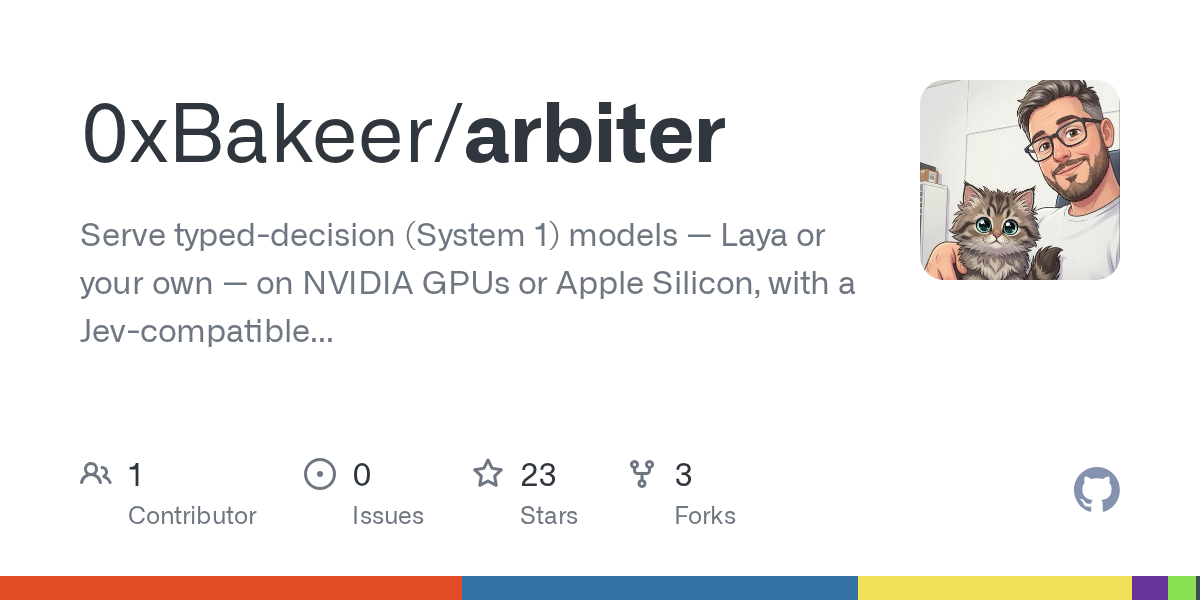
The repository's own description: “Serve typed-decision (System 1) models — Laya or your own — on NVIDIA GPUs or Apple Silicon, with a Jev-compatible API and coding-agent integrations”
How it works
The model runs in a local process, a request carries the state and the questions together, and the response returns an answer and a probability distribution per question from a single forward pass.
The repository, by the numbers
Read from the GitHub API on 2026-09-24. Stars and the last push move daily — quote them with the date, the way we do.
What we checked
- the README and the build write-up it links, read 2026-09-24
- the compatibility claim and the API section that backs it
- the licence file
What we did not check. Behaviour under concurrent load. The repository documents a working single-machine setup, not a throughput measurement, and we did not load it.