GitHub · Research and data
jaredpalmer/kev
If you would rather own the model than call one.
What it does
A small family of Jev-like decision models you can train and run yourself. The README links three sizes on Hugging Face — 0.8B, 4B and 9B — built on top of Qwen3.5, and the repository ships the training path as a skill rather than a notebook dump.
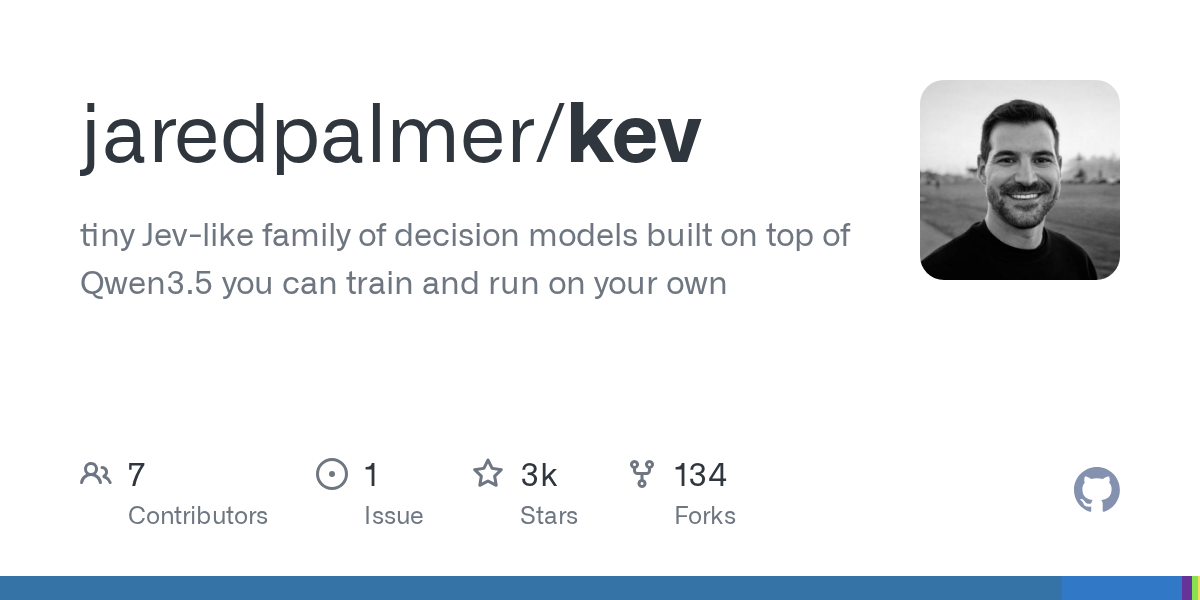
The repository's own description: “tiny Jev-like family of decision models built on top of Qwen3.5 you can train and run on your own”
How it works
`kev/` is the package, `experiments/` and `runs/` hold training runs, `evals/` holds evaluation, `skills/kev-finetune` packages the fine-tuning workflow for an agent, and `space/` is the hosted playground.
The repository, by the numbers
Read from the GitHub API on 2026-09-22. Stars and the last push move daily — quote them with the date, the way we do.
Numbers the author reports
These are the project's own figures, not our measurements — we keep ours on the statistics page and label them as ours. Read on 2026-09-23, with the sentence each figure appeared in:
- 118 msone 101-token request on Kev-4B in bf16 — Kev's own local model, not Jev
- “measured on Kev-4B on an L4 with three questions and 20 requests per row … | bf16 (default) | 118 ms | 189 ms |” — repository README
What we checked
- the tree: evals, experiments, runs, skills/kev-finetune, space, tests
- Apache-2.0 LICENSE
- README links a Hugging Face collection with three model sizes
- the description says the family is trained on top of Qwen3.5
What we did not check. We did not train or run any of the three sizes, and no accuracy figure appears in the README.