Jev on X
The model arrived with a launch post and no tutorial, so the explaining happened in public. These are the posts that mattered — the vendor's own announcements, the platform confirmations, the benchmarks people ran, the first-week sceptics — each described in a sentence of ours and linked back.
101 posts described Likes read 2026-09-27 The projects behind them: builds
- X

@CompleteSkeptic · video
The launch post: 20–200× faster, and it cannot write
The launch post itself: the founder on why superhuman chat models did not lead to AGI, and what he built instead — 20–200× faster, 40–400× cheaper, and it cannot write a sentence. Every number in it is the vendor's, dated 15 September 2026, and the clip is the announcement read out loud.
- X

@tamarajtran · video
Instant compaction: score the tool calls, drop what does not matter
Compaction turned into a scoring problem: grade every tool call, drop the ones the model judges irrelevant, and skip the summarisation pass entirely. The most-liked post we have catalogued, and the idea that two later posts in this same column argue with.
- X

@heystefan_ · video
The designer's demo that reached the design crowd
A designer's demo, and the most-liked post in this batch: the audience is design people, not AI people, which is worth noticing about who the model reached. The clip is the content; there is no benchmark in it.
- X

@gregpr07 · video
Browser Use + Jev searched a flight in seven seconds
The most-liked post in the whole list, and the one behind the browser-use repository we already cover: a flight search in seven seconds for under half a cent. Author's numbers.
7 s the flight search in the clip, and $0.0039 for it the post's own text
- X

@altryne · image
A Claude plugin that trims tool results with Jev
The most-liked post here: Jev working as a plugin inside Claude, for review work. The interesting part is the shape rather than the excitement — a large model writes, Jev decides.
1 s one review pass over a Claude session, 1M → 86K tokens the post's own text
- X

@rronak_ · video
An agent beat the Ender Dragon in 8 minutes 43 seconds
An agent loop playing Minecraft end to end, with the decision model choosing each move and a language model out of the loop. A game is the cheapest place to watch that loop fail: every wrong call is visible within a second.
-

@NathanFlurry · post
Jev does not replace GPT or Claude
The most-liked explanation in this list, and the only one whose opening move is to say what Jev does not replace. Start here if the rest of the column reads as enthusiasm.
- X

@TheMattBerman · video
724 competitor ads broken down in forty seconds
Seven hundred competitor ads broken down in forty seconds — every hook and format classified, one decision per ad. This is the largest corpus in the column so far and the clearest case for the model as a labelling engine.
- X


@trycua · image
A third party's own System One family (not Jev)
Not built with Jev: this is a third party announcing its own family of System One models, which is the clearest sign that the category now exists outside the company that named it. Kept in the column because the comparison is the news.
- X


@akshay_pachaar · image
Jev clearly explained: what it is and what it is not
The most-liked thing we have read from the second wave — over five thousand likes — and it is an explainer rather than a benchmark: why using a language model for a bounded decision is a hammer, and what the alternative looks like when you only need a choice.
- X

@jarrodwatts · video
A bot that decides every 300 ms block and trades on an on-chain book
A bot that asks Jev whether to buy or sell from a price feed and places the order on an on-chain order book every three-hundred-millisecond block. Real money on a real venue is the claim, and it is one we have not checked against the chain.
- X
@CompleteSkeptic · video
Doom at ten decisions a second, about seven dollars an hour
Doom played at roughly ten decisions a second, which the vendor works out to about seven dollars an hour of model calls. The cost of a continuous loop is the number this column keeps needing, and here the company that sells it put the arithmetic in public.
- X

@jpschroeder · video
Tesla's driving agent rebuilt in an afternoon
A driving-simulation agent rebuilt in an afternoon, with the decision model steering. 'Under an hour' is a claim about the integration rather than the task, and the author is explicit that it took one sitting.
- X


@moritzkremb · image
The coolest Jev projects on X, in one thread
A curated thread of Jev projects from X: the same instinct as this column, by somebody reading the same timeline. Overlaps our builds list and belongs beside it.
- X

@nailthy62 · video
Real-time virtual try-on for a fashion haul
Real-time virtual try-on for a fashion haul: a decision per frame rather than per document, which is the latency end of what these models are for. The demo is a studio experiment, not a product, and the author says so.
- X

@rileybrown · video
500 emails classified in seconds for a few cents
Five hundred emails classified in seconds for a few cents, which is the claim; the number is the author's and we have not run it. The interesting part is the shape — bulk triage where per-item cost decides whether it is viable at all.
- X

@OpenRouter · video
Jev is on OpenRouter, in beta
OpenRouter's own announcement of the beta listing — the post that made the model reachable without a waitlist, and the reason the listing page this site links to exists at all.
- X

@ryanvogel · video
1,500 of one person's own emails, classified
One person running fifteen hundred of his own emails through the model and reporting that it works well. A personal inbox is a fair place to start and also the reason the post carries no accuracy figure: the only labels in it are his own.
- X

@romanbuildsaas · video
Seven hundred outreach messages scored in forty seconds
Seven hundred leads and the outreach message written for each one, scored in forty seconds for nine cents, with mismatches between message and lead flagged. Judging a written sentence against an intent is the errand; the accuracy claim is the author's and there is no holdout in the post.
-

@0xCodila · post
Jev as an “Internet moment” for the AI industry
The strongest version of the hype, posted as text. Read it for how the analogy is argued; the post itself offers no number, and none of the claims in it are ours.
- X

@alexchristou_ · video
Years of bookmarks, run through Jev
The joke that travelled furthest in this batch: years of bookmarked posts as a workload for a fast decision model. The demo is the point.
- X
@moritzkremb · video
A full Jev tutorial: what it is and what to build
The fullest tutorial in this batch — what it is, how to build with it, what it unlocks. Long, and the nearest thing to the official walkthrough that was never published.
- X
@akshay_pachaar · video
LLMs vs Jev: the difference is not what you think
A widely shared explainer whose first move is to say the key difference is not speed. Short, and the numbers inside it are the vendor's, as they are everywhere else in this column.
-

@LangChain · post
LangChain benchmarked Jev against LLM judges
The most consequential post in this batch, and not because of the numbers: a framework company ran the comparison everyone else has been arguing about from intuitions. They tested Jev against LLM judges on accuracy, repeatability, latency and cost, and published the method rather than the conclusion.
- X

@faadilhshaik · video
Super Mario Bros played by the decision model
Super Mario Bros played by the model, which is the earliest demo in this batch and the one that convinced a lot of people the latency claim was real. A game loop is the honest test of whether the round trip fits.
- X

@SUOHA_AI · video
The co-founder's own nod to the Claude Code workflow
A Chinese-language clip about long coding sessions where the context window fills up. The co-founder reposted it, which is how it reached this list.
- X

@iam_zachi · video
A Postgres function that judges rows in plain English
A Postgres extension that judges rows in natural language with no index and no embeddings: one function inside a WHERE clause, a hundred and twenty-nine rows in about a second. The demo is small and the shape is not — a filter that can read what a column means.
- X


@jaredpalmer · image
Kev-0.5B: a Jev-like model you can train on a laptop
The release of the most-starred open imitation: a 0.5B Jev-like decision model with a TypeSafe-compatible API, trainable on a laptop. Posted by a developer whose projects are usually infrastructure, which is a signal about who is watching this category.
-

@iannuttall · post
Starting with Jev: install the skill
The shortest useful post here: one command that installs the vendor's own skills. As much a resource as a demo, and how most people in this list started.
-

@theo · post
The argument against Jev-shaped compaction
A well-known developer arguing the compaction plugin is the wrong approach. The most useful dissenting post in the list, and it is aimed at a build we cover.
- X

@0xCodez · video
The founder on why the next era is not the coding-agent era
A clip of the founder arguing that the next era is not coding agents. Worth having as the vendor's own framing of the direction — and worth remembering it is a claim about where things go, not a measurement.
-

@paarangatrai · post
The easiest way to understand Jev
Two sentences that became the most-quoted explanation: models generate answers, Jev makes decisions. Nothing here to verify and everything to quote.
-

@studio_yebisu · post
A Japanese roundup of Jev repositories
A Japanese post collecting the Jev repositories that look practically useful, especially for computer use and automated trading. A collection, so it belongs in resources too.
- X


@DataChaz · image
The “up to 193x” figure, as the vendor states it
Quotes the vendor's up-to-193× faster claim while framing it as the maker's number. We have not reproduced that measurement, and the row says so rather than repeating it flatly.
-

@RohOnChain · post
A trading loop built on Jev's sub-100 ms claim
The trading post with numbers rather than adjectives: a decision per block, under 100 ms, 24/7, with a written walkthrough of building the loop. It also shows how this model gets sold on X — as a latency story first and a calibration story second, which is not the order the vendor's own benchmark uses.
- X

@milindlabs · video
Computer use where no pixel leaves the machine
Computer use with no screenshots and no DOM: a local model segments every button on screen, on-device OCR reads the labels, and only that text reaches Jev. Keeping the pixels on the machine is a design decision rather than a trick, and it changes what the model has to be good at.
- X

@0xidanlevin · image
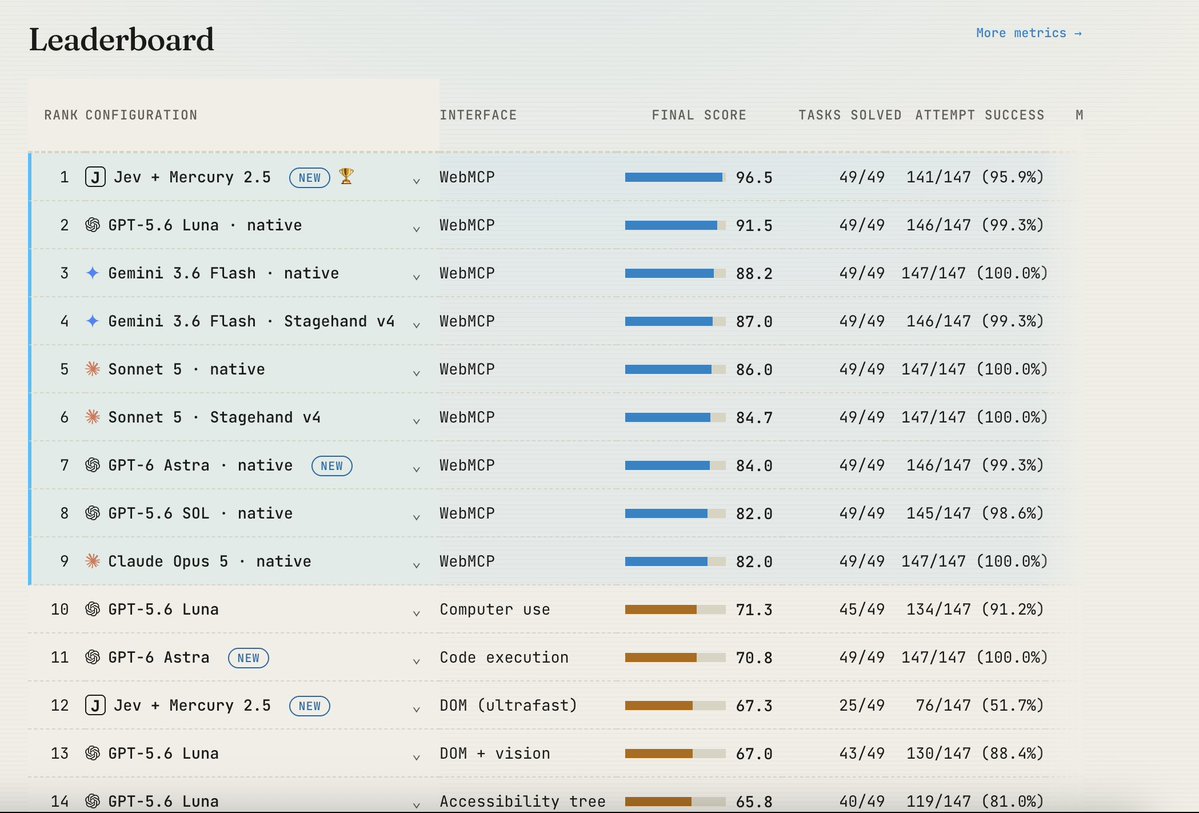
Jev and a small LLM won a WebMCP benchmark at 112× lower model cost
A WebMCP benchmark where Jev paired with a fast small language model solved every task at roughly 112× lower model cost than a frontier model driving a browser with code execution. The benchmark belongs to the company selling the tooling, so the multiple is their number, not a neutral one.
- X

@nutlope · video
1,018 research papers labelled for eight cents
1,018 research papers sorted into twenty-four topics for eight cents, 256 milliseconds median per paper, with a fast language model writing the summary that Jev then labels. The two-model pipeline is the reusable shape, and the per-item cost is the number worth keeping.
-

@fullctx · post
What Jev does in a browser, in seven actions
The plainest description of what the model does in a browser, and it is almost a specification: look at the page, see the real buttons, pick one of seven actions. Worth a card because it explains the category without a benchmark in sight.
- X

@danshipper · image
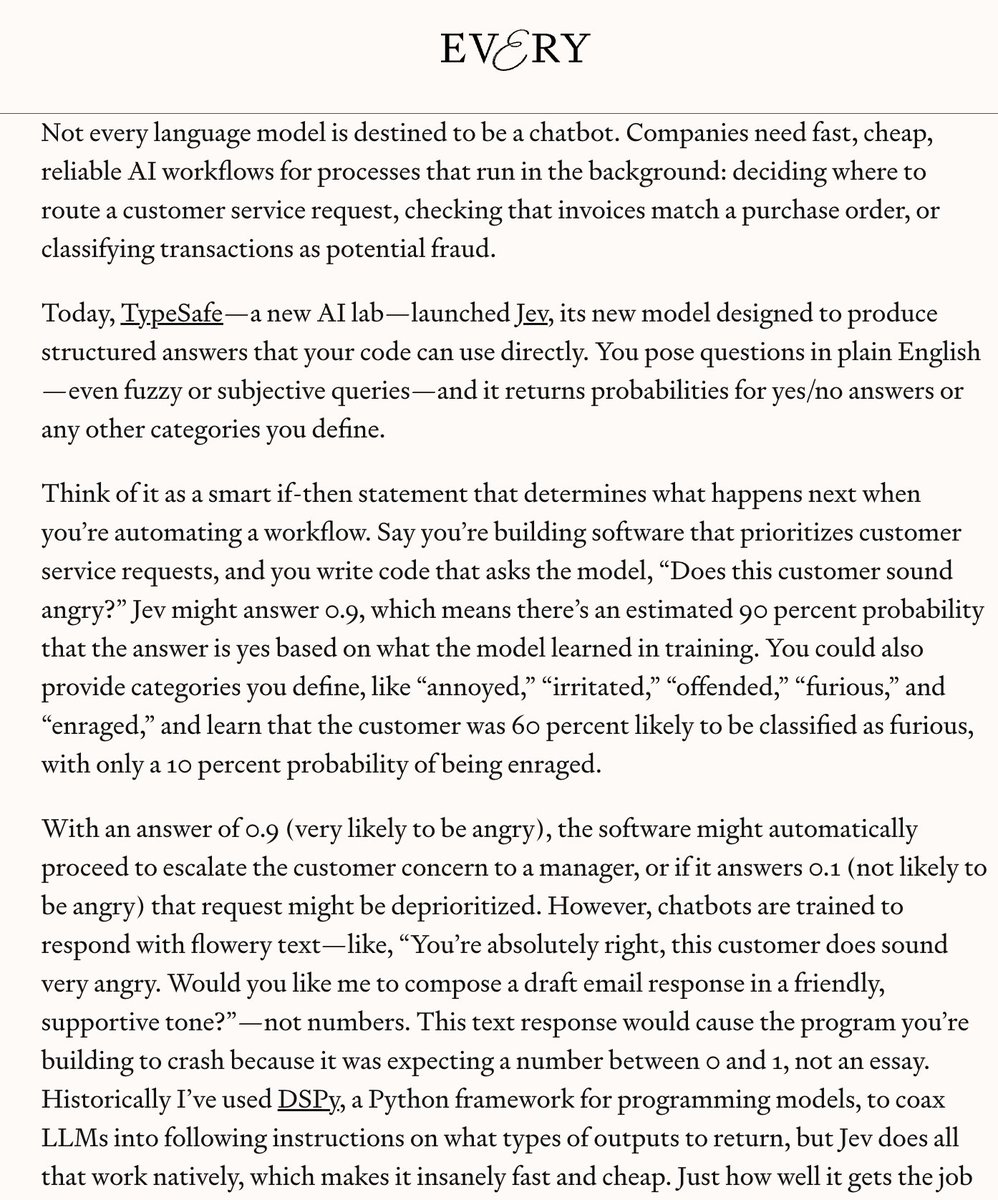
A week of testing at Every: probabilities instead of words
An editor at a media company on a week of testing the model, making the point the whole column keeps returning to — that the output is a probability rather than a word, which is what lets a decision sit inside a loop. One operator's judgement, no benchmark.
- X


@0xLogicrw · image
An Awesome Jev list for people with a key and no plan
A Chinese-language post that assembled an Awesome Jev list within a day of getting API access. The same shape as the resource columns on this site: the value is in what got included, not in the commentary around it.
- X

@0xRicker · video
Jev Engineering turns an agent stack into a control system
A video version of the same argument: Jev as the thing that turns a stack into a control system. Watch it for the vocabulary, which is spreading faster than the model is.
- X

@gregisenberg · video
What Jev is, and what it lets you build
The clearest of the explainer videos, and the one aimed at people wondering what business it unlocks rather than how the mechanism works.
-

@swill1ams · post
The prediction: custom Jev-style models
A prediction rather than evidence, kept because it names the mechanism — parallel constrained decisions — and shows what this audience is betting on.
- X

@robj3d3 · video
Sixty-one questions per post in about a second
Sixty-one questions scored on every post in about a second for a fraction of a cent — the strongest per-item economics claimed in this batch, and like the rest, a claim by the author. The questions themselves are the interesting part: many decisions, one state.
- X

@leojrr · video
X's published weights, a global feed, and Jev calling how a post travels
The X feed rebuilt on the weights X published, with Jev deciding how far a post will travel. “Insanely accurate” is a claim and not a measurement — the part we can check is that the simulation needs a global feed of everybody's posts to be interesting at all.
- X

@coolish · video
Slay the Spire 2 at seven tenths of a second a turn
Slay the Spire 2 played at seven tenths of a second a turn, visibly faster than the frontier model the author had used for the same game. A Chinese-language post and a feel claim rather than a win rate; the clip is the evidence anyone can check.
- X

@jonymusky · video
A four-minute explanation in Spanish
A four-minute Spanish explainer that states what Jev does not do before what it does — the clearest non-English treatment in the list.
- X

@marcelpociot · video
A browser extension that hides timeline posts on your rules
A browser extension that hides or collapses posts in the timeline on the reader's own rules — Jev making one decision per post, in the feed, at scroll speed. Worth keeping as an example of the decision living inside somebody else's page rather than a pipeline of ours.
- X

@sarah_edo · video
A Chrome side panel that drives a page's own WebMCP tools
A Chrome side panel that reads the page's own WebMCP tools and, on every keystroke, picks the one that fits, fills in its arguments and says how sure it is. The confidence number reaching the interface is the interesting half. We have not installed the extension.
- X

@tdinh_me · video
An extension that spots the sponsor read and skips it, live
An open-source extension that listens to a YouTube video, spots the sponsor segment and skips it, for roughly half a cent of model spend per video. Deciding against live audio rather than a transcript is the hard part, and the author published the code and its bring-your-own-key setup.
-

@CloudflareDev · post
Jev is live on Cloudflare AI Gateway
Cloudflare's developer account announcing Jev on AI Gateway. A platform confirmation rather than an opinion, which is the kind of primary source a resource index should carry.
- X
@OpenRouter · image
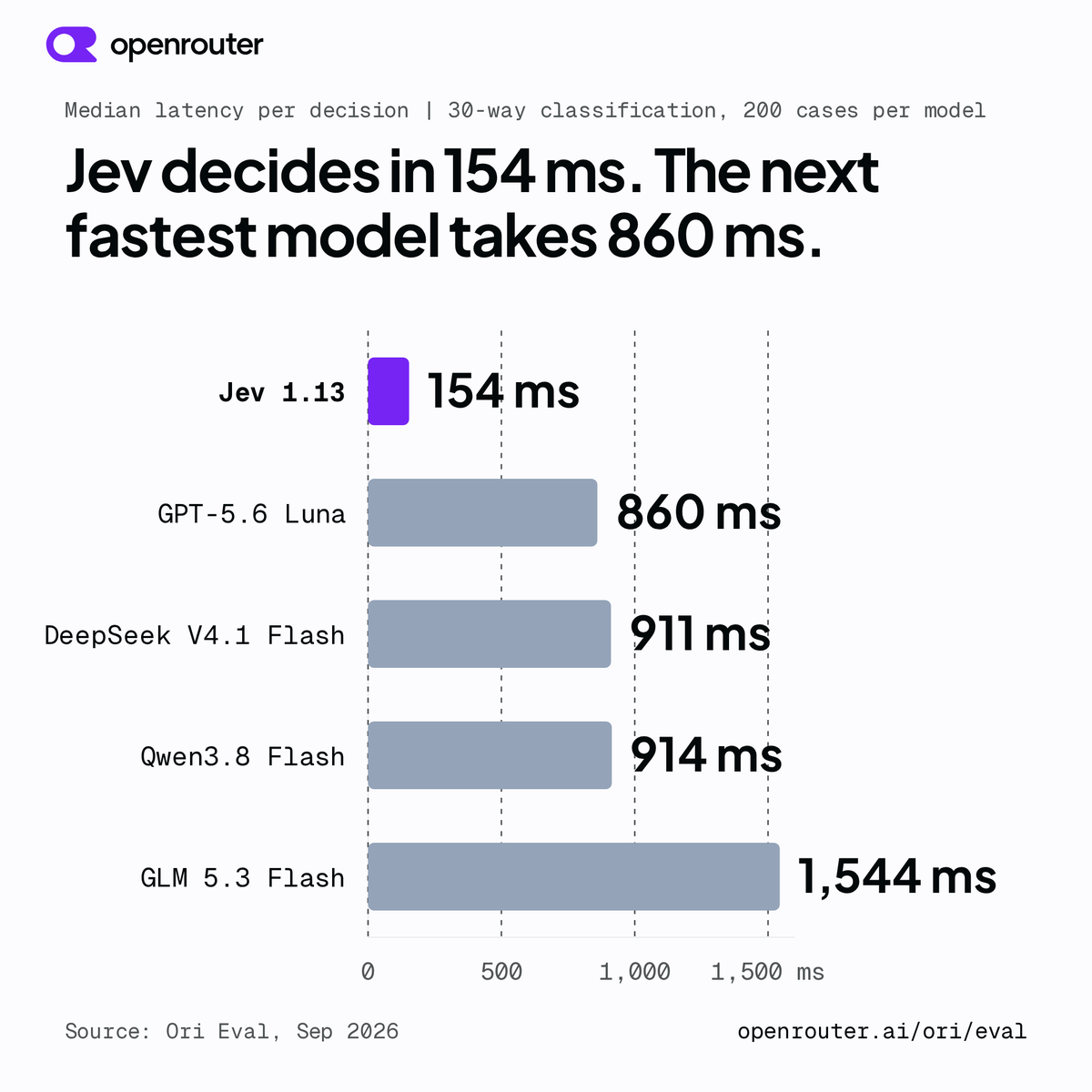
The router's own evaluation of Jev
The router's own evaluation of Jev, published by the company that serves it. We treat it as a vendor-adjacent source rather than an independent one, but it is the closest thing to a neutral party that has measured the model in public.
- X

@venturetwins · video
Natural-language search over thousands of Zillow listings
Natural-language search over a listing site, with Jev as the filter between a shopper's sentence and thousands of property records. It is the same job the triage pages describe done on a different corpus: a large candidate set narrowed to a handful by one pass.
- X
@rileybrown · video
A draft scored for viral potential half a second after you stop typing
A writing surface that scores a draft's viral potential half a second after the typing stops, and labels what kind of post it is at the same time. The author says making it good would need a lot of scraped X data — the honest half of the post, and the reason it is still a demo.
- X

@jerryjliu0 · video
DocJev splits and classifies complex document packets
Document packets classified and split by a tool its author built on Jev, with the default configuration tuned for exactly that shape of input. The claim is speed on complex packets; the evaluation behind it is the author's.
- X

@N8Programs · image
Somebody tested the Terra-tier claim, and it held
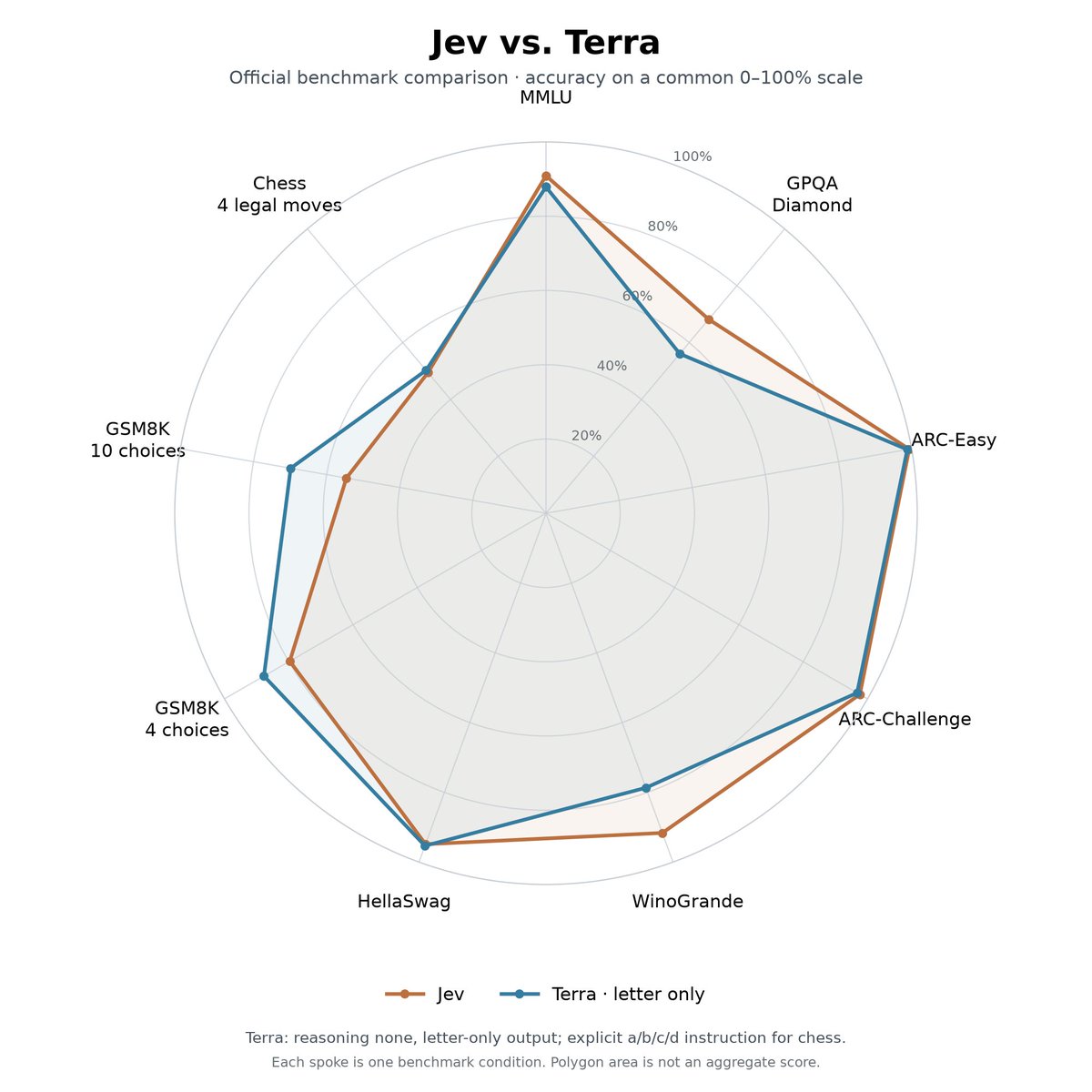
Somebody finally tested the sentence rather than the demo. He took Jev's claim of intelligence comparable to a frontier model on System One tasks and ran both on multiple-choice benchmarks with reasoning turned off — and came back with "Jev is Terra-tier", which is a stronger result than the claim it was checking.
- X


@0xMovez · image
Jev Engineering in ten steps
A ten-step article about putting Jev where an LLM was doing the cheap work inside an agent loop — the same case our builds column keeps finding, written as a walkthrough with the setup included. The numbers in it are the author's, not ours; 750 likes and 31 replies at the time we read it.
- X
@nutlope · video
Fraud triage in two stages: Jev sorts, a large model reads the rest
Fraud triage in two stages: Jev labels a hundred emails in 1.42 seconds, then the uncertain ones go to a large model — ninety-six of a hundred right for about seven cents. The accuracy is self-reported; the routing pattern is the part worth copying, and it is what the whole site argues for.
- X

@mdlahfir · video
Using Jev for local harness and model routing
A developer using a decision model to route between Claude Code, Codex and opencode: the practical version of the routing argument made elsewhere in this column.
-

@h_nilforoshan · post
A 2.5-million-user product benchmarked Jev on résumés
A Stanford PhD running a hiring product with 2.5 million monthly users benchmarked the model on the task his company actually pays for: scoring how well a résumé matches a job. Production numbers on a real workload are rare in this topic, and he shows the method.
- X


@cocktailpeanut · image
Jev did not reinvent classification
The most precise framing we found — not a new classifier, but arbitrary classification made cheap enough to put inside a loop. Read this before the vendor's own claims.
- X

@kylejeong · video
Browser use at a tenth of a cent a task, with Stagehand
Browser use priced at a tenth of a cent a task in a remote browser: the accessibility tree goes in as state, candidate actions go in as questions, and the chosen action comes back. It is the same loop every computer-use demo here uses, minus the screenshots.
- X

@cline · video
A coding assistant hands the model a browser
A coding assistant plugin that hands the model a browser, so a decision can be made after looking rather than from memory. The integration is the contribution; the post is a demo and we have not run it.
- X


@fazxes · image
Benchmarking a safety classifier against Jev
A benchmark post with a concrete result: roughly 5-18x faster on a safety classifier. Their numbers, their harness; it is listed because they published the setup.
-

@manish_fp · post
Ten articles and five hours of video, compressed into one explainer
Ten articles and five hours of video, compressed into one explanation with a reading list at the end. The genre is new enough that the explainers are still being written, and this one is explicit about what it read to write itself.
-

@da_fant · post
The “10x faster and cheaper” routing claim
A thread on model routing as the first place a decision model pays for itself. The 10x in the opening line is the author's claim, not a number we checked.
- X

@akshay_pachaar · image
Build a Jev judge: evaluation as a bounded decision
Takes the same argument to evaluation: if the judgement is a handful of bounded decisions, does it need another round of text generation to make it? The most concrete Jev-as-judge case we have found on X, and the one we would test before relying on it.
-

@xiaomovps · post
Five open replications, five days after launch
A Chinese-language roundup of five open replications, with parameter counts and platforms — evidence for the copy-the-pattern claim that the Kev repository makes alone.
- X

@zodchiii · video
The founder's “biggest breakthrough” framing
Another founder clip, this one making the breakthrough claim directly. Grouped with the earlier founder video so both of his framings sit side by side.
- X

@hedachi · video
A visual restyling of the timeline, one decision per post
A visual restyling of a timeline, driven by per-post classification. Japanese-language post, and the demo is the point rather than a benchmark — it shows the decision feeding a rendering layer.
-

@iwashi86 · post
Notes on reverse-engineering Jev from ten thousand calls
A Japanese engineer's notes on an article that reverse-engineered the architecture from about ten thousand API calls. The closest thing here to the architecture conversation.
-

@mvanhorn · post
Multiple choice, not essay writing: Jev as an ELI5
An explainer aimed at people who have never heard of the model, summed up in the line worth keeping: think multiple choice, not essay writing. Useful as the single link to send somebody who asks what this is — and the 200x speed claim in it is the author's, not a measurement.
-
@mvanhorn · post
Nine things people are building, summarised
The companion post to the article above, listing nine things people were already building. A week-one snapshot, useful even where our builds column disagrees with it.
- X

@tonnoz · video
The use cases people keep missing
A short clip arguing the use cases are still being missed. Enthusiastic rather than technical; its value is the specific examples it names.
-

@jiayuan_jy · post
A day with Jev, and a deflating conclusion
A sceptical Chinese-language note: after a day of study the author reads Jev as a faster general classifier that an LLM could equally do. The counterweight this column needs.
-
@0xRicker · post
Jev as the control layer agents are missing
Argues that Jev belongs as the control layer rather than inside the model call. The seconds figure in the post is the author's framing of agent latency, not something we measured.
- X
@iannuttall · video
A free internal-linking tool that picks the links worth adding
A free internal-linking tool that classifies a page and picks the links worth adding — an SEO chore turned into one decision per candidate link. The author published it for anyone to use, which is why it is worth having in the column.
-

@isaac_flath · post
Six things I tried with Jev
Six uses the author kept after trying them, with the ones they dropped left implied. Small reach, and the only entry reporting a durable personal workflow.
- X
@iannuttall · video
Filtering the reply spam X's own moderation misses
A tip rather than a project: a filter for the reply-guy comments X's own moderation misses, assembled inside a coding agent in about five minutes. The five minutes is setup time, not a measurement of anything else, and the filter itself is a few lines of prompt work.
- X

@designgurra · video
Auto-tagging inside a design tool, while the UI is being used
Auto-tagging in a design tool: one decision per element, shown while the interface is being used. A short demo, but it is the clearest picture of the decision as a UI primitive rather than a backend job.
- X

@airesearch12 · video
JevBench published its first leaderboard
The launch of JevBench, a reproducible benchmark for this class of model, with Jev's first score on it. Whatever one thinks of a benchmark written by the community it measures, this is the artefact that made comparison possible — before it, every number in this topic came from a different ruler.
-

@Kostastsale · post
Where Jev fits in security engineering
A security engineer's account of where a decision model fits in that work — a question the vendor's launch post never answers.
- X
@moritzkremb · video
A sales copilot that decides what to say next, live
A live sales copilot that listens to a call and decides what to say next — a real-time loop where a wrong answer is expensive and a slow one is useless. The proof is a demo video; there is no evaluation in the post.
- X

@desertantlabs · video
An on-device audio pipeline with no language model in the loop
An on-device audio pipeline where the decisions happen locally and no language model is in the loop at all. It is the strongest version of the self-hosting argument on this column: the pieces that need a GPU are not in it.
- X


@RoundtableSpace · image
Five repositories a newcomer is told to start with
A five-item list of repositories, and worth a card because it is what a newcomer sees when they search: ultrafast for browsers, skills for agent plumbing, a trader, and two more. Lists like this are how most readers meet the ecosystem, so we track them.
- X

@meetshukla_ · video
Ten thousand imported videos given a reaction each
Ten thousand imported videos getting a reaction classification each, at a scale where the per-item price is the whole feasibility question. The author is candid that the import was theirs to regret.
- X

@GoSailGlobal · video
Cold water on Jev for search reranking
A negative result worth keeping: on their reranking test, Jev alone did not beat vector search. The only post in this column reporting that something did not work.
- X

@wallstengine · video
Launch-day coverage: the three claims that travelled
Launch-day coverage from a markets account, and the cleanest statement of the three headline claims that were repeated all week: twenty to two hundred times faster, forty to four hundred times cheaper, and a price per million tokens. All three are the vendor's; the post is how they travelled.
- X

@ErickSky · image
On agents that no longer carry the whole context
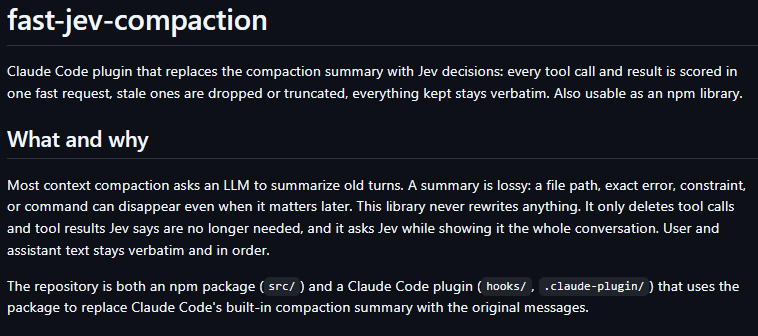
A Spanish-language reaction noting that the agent's context stops feeling like a black box. Small reach, and the only post here making that particular observation.
- X

@Orus_agent · video
Orus put Jev in front of its trades as a reviewer
An integration rather than a demo: Jev now reviews the trades an agent's strategy proposes before they happen, and can refuse them. The interesting part is where the model sits — after the strategy, before the order — which is the opposite of letting it generate the strategy.
- X
@GoSailGlobal · video
255 options, a few hundred milliseconds, one calibrated answer
A Chinese-language walkthrough of what a multiple-choice-only model grows into: up to 255 options, a few hundred milliseconds, and a calibrated confidence attached.
-

@NatalieMarleny · post
The case for Jev as the router rather than the task
The argument that the model's home is the router rather than the task: every automation stack already has a controller, and that controller is where the cheap decisions pile up. It is a post about architecture, and it is the clearest statement of the case in this batch.
-

@vesko_st · post
A product engineer testing whether Jev understands the text first
A product engineer testing the model on the part of the job everything else depends on: whether it understands the text before it decides anything about it. The post is a sequence of measured probes rather than a verdict, which is why it is on the wall.
- X

@ilijabogunovic · image
Jev on 450 WikiRace games: cheap, fast, short on world knowledge
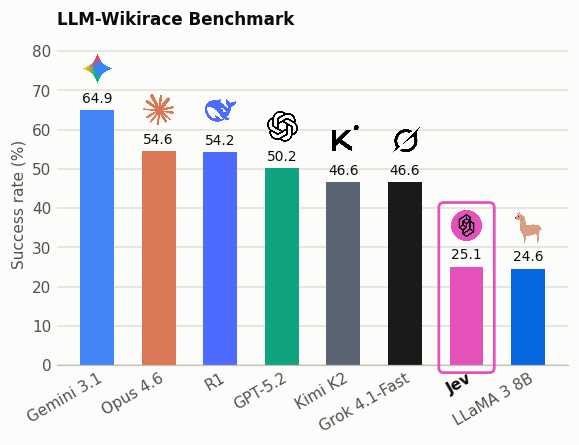
Somebody ran the vendor's headline demo on their own benchmark and published the verdict that hurts: fast and absurdly cheap, and short on the world knowledge and planning the demo implies. Four hundred and fifty games, eight hours, under a dollar — the cost claim holds even where the capability one does not.
- X

@kraayenJon · video
Three days after launch, 205 people were on the directory at once
Three days after launching, the same author posted his traffic: 205 people on the site at once. It is a post about a website rather than about the model, and it is here because the demand for a place to look at what people built is itself the finding.
-

@VaibhavSisinty · post
A flight-search agent that answers in seven seconds
A browser agent that searches flights in seven seconds for under half a cent, built on the open harness. The cost figure is the part worth keeping: it is the same shape as the launch number we measured against, but from somebody with no stake in either model.
- X

@YouWareAI · video
Twenty-seven questions in one call, and three demos
A demo post that names its own inputs: twenty-seven questions in one parallel call, a Doom bot driven by structured game state, and a WikiRace run in 0.419 seconds. The last one is the same benchmark a sceptic in this batch used to argue the model is short on world knowledge, which is why both are on the wall.
- X
@kraayenJon · video
One URL in, a slop score out: 35 tells in 243 ms
One URL in, a slop score out: thirty-five tells checked in 243 milliseconds for about $0.00015 of tokens. The tells are the author's own list of design clichés, so the score measures his taste as much as the page — and it had two likes when we read it.
- X

@kraayenJon · image
The directory of Jev demos passed three hundred entries
The author of the directory this site's topic pages were modelled on, saying he has documented over three hundred demos. We cite this because the reference is real: our own X column exists because that listing showed what a model's week looks like when somebody collects it.
- X

@kraayenJon · image
A second list of Jev repositories, posted while the topic climbed
Another list of the repositories people were building with, posted while the topic was still climbing and carrying almost no engagement. Nothing in it is new to our resources column; what the row shows is that a second-hand list market appeared within a week.
101 of 101 posts have a record of their own Send us one we missed
What the like counts are, and are not
They are a snapshot, taken when we read each post on 2026-09-27 — not a live feed. A like count keeps moving after we look; the ones on this page do not. That is deliberate. X's read API is priced (ADR-0023 — the free tier is write-only), and the endpoint that fills these rows is the widget endpoint a browser uses to draw an embedded post. We read it once, write the number down with the date, and do not poll it: a number that updates itself is a number nobody can check.
So the ordering on this page is "most liked when we looked", which is a weaker claim than "most liked" and an honest one. Where a post's own words carry a figure — a latency, a cost — it goes on the card as the author's, with the sentence it came from.