Use case · Browser agents
Jev for browser agents
Driving a browser: clicking, reading, deciding the next step.
22 items, from every source we cover All use cases
- X
X · video
🎇 I made a small Chrome extension: a side panel that drives any site's WebMCP tools with Jev…
A Chrome side panel that reads the page's own WebMCP tools and, on every keystroke, picks the one that fits, fills in its arguments and says how sure it is. The confidence number reaching the interface is the interesting half. We have not installed the extension.
- GitHub
GitHub · project
awlevin/typesafe-computer-use
Computer use for about $0.0002 a step, on macOS: OCR the screen, classify the next action with TypeSafe, click. Python 3.12 with an MIT licence and a CI badge, and the price per step is in the repository description rather than buried in a table. We have not run it.
- X
X · video
Breaking: Browser Use + Jev = Ultrafast ⚡ Findings flights took 7s and cost only $0.0039 🤯 &…
The most-liked post in the whole list, and the one behind the browser-use repository we already cover: a flight search in seven seconds for under half a cent. Author's numbers.
-
X · post
Browser agent that finds flights in 7 seconds for $0.003. Connected Jev to Browser Use. Built…
A browser agent that searches flights in seven seconds for under half a cent, built on the open harness. The cost figure is the part worth keeping: it is the same shape as the launch number we measured against, but from somebody with no stake in either model.
- GitHub
GitHub · project
browser-use/jev-ultrafast
The browser agent we read line by line for the resources column: Jev picks the next action from an indexed space instead of emitting free-form clicks. The most-starred build in this list, and the one with the clearest engineering write-up.
- X
X · video
got @typesafeai’s new model Jev to play Super Mario Bros. fast inference + structured outputs…
Super Mario Bros played by the model, which is the earliest demo in this batch and the one that convinced a lot of people the latency claim was real. A game loop is the honest test of whether the round trip fits.
- X
X · video
I built a browser extension with Jev @typesafeai that can hide/collapse posts on X based on n…
A browser extension that hides or collapses posts in the timeline on the reader's own rules — Jev making one decision per post, in the feed, at scroll speed. Worth keeping as an example of the decision living inside somebody else's page rather than a pipeline of ours.
- X
X · video
I rebuilt Tesla Full Self Driving with Jev in less than an hour. This model is a total unlock…
A driving-simulation agent rebuilt in an afternoon, with the decision model steering. 'Under an hour' is a claim about the integration rather than the task, and the author is explicit that it took one sitting.
- X
X · video
Jev + Astra beats the Ender Dragon in Minecraft in 8 minutes 43 seconds! ⏱️ Cost less than $1…
An agent loop playing Minecraft end to end, with the decision model choosing each move and a language model out of the loop. A game is the cheapest place to watch that loop fail: every wrong call is visible within a second.
- Hacker News

Hacker News · thread
Jev Ultrafast: A browser agent with a dynamic, indexed action space
A browser agent driving an indexed action space. We read this repository line by line for the resources column; the thread is where its author answers questions about it.
-
Hacker News · thread
Jev Was Full, So My Agent Moved Into My Browser Instead
What happened when the hosted model hit its rate limit: the agent moved into the browser and kept working locally. A practical answer to the capacity question, found by a person who hit it rather than by a load test.
-
X · post
Just found Jev. Jev looks at the page, sees the real buttons, and just picks: click this one,…
The plainest description of what the model does in a browser, and it is almost a specification: look at the page, see the real buttons, pick one of seven actions. Worth a card because it explains the category without a benchmark in sight.
- X
X · video
Okay so Jev can actually do computer use really well Without any screenshots, or LLMs and no …
Computer use with no screenshots and no DOM: a local model segments every button on screen, on-device OCR reads the labels, and only that text reaches Jev. Keeping the pixels on the machine is a design decision rather than a trick, and it changes what the model has to be good at.
- GitHub

GitHub · project
Sac-Y/Jev-cu
The one repository in this queue with no published description, and the one that states its design constraint most plainly: text goes in and screenshots do not, a local policy gate blocks the sensitive actions, and Codex does the reading and clicking. The README is in Chinese.
- Hacker News

Hacker News · thread
Show HN: CUA-S1 – A System One Model for Computer Use
A separate System One model, aimed at computer use rather than typed decisions. The clearest sign that the name is turning into a category rather than a product.
- X
X · video
We built a plugin that gives Jev a browser in Cline, and have been blown away by the results.…
A coding assistant plugin that hands the model a browser, so a decision can be made after looking rather than from memory. The integration is the contribution; the post is a demo and we have not run it.
- X
X · video
we built blazing fast computer/browser use with Jev + @Stagehanddev. this task cost $0.001 an…
Browser use priced at a tenth of a cent a task in a remote browser: the accessibility tree goes in as state, candidate actions go in as questions, and the chosen action comes back. It is the same loop every computer-use demo here uses, minus the screenshots.
- X
X · image
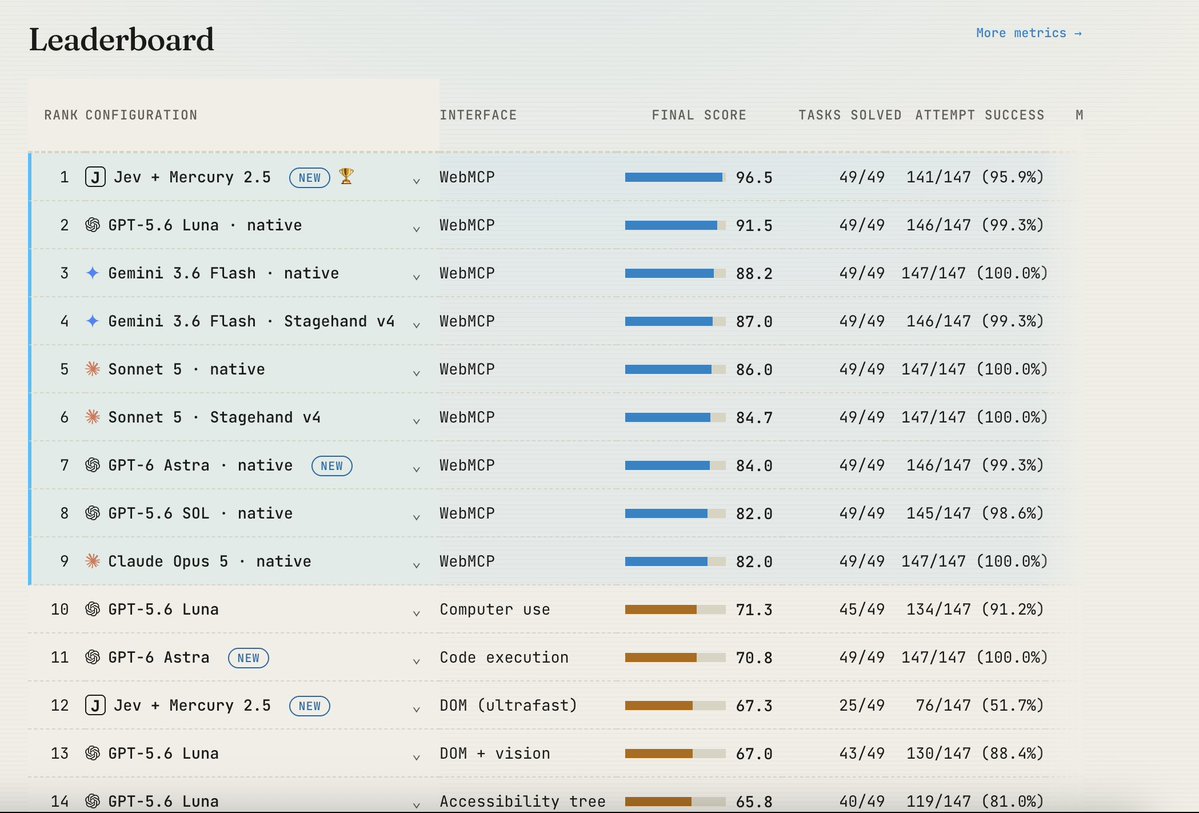
We just ran Jev on our WebMCP benchmark. The result: basically broke the benchmark. Jev + Mer…
A WebMCP benchmark where Jev paired with a fast small language model solved every task at roughly 112× lower model cost than a frontier model driving a browser with code execution. The benchmark belongs to the company selling the tooling, so the multiple is their number, not a neutral one.
- X
X · video
We love how this doomo doomonstrates real-time intelligence and what can be doone with code +…
Doom played at roughly ten decisions a second, which the vendor works out to about seven dollars an hour of model calls. The cost of a continuous loop is the number this column keeps needing, and here the company that sells it put the arithmetic in public.
-
GitHub · project
wy-coliney/jev-browser-use
A browser skill that splits the loop in two: Jev owns clicking, toggling, scrolling and navigation, while Codex keeps text input, visual judgment and the final verification. The README claims 5–10x faster browser operations in the author's own product workflows at EZCollegeApp.
-
X · post
やぁ!兄弟たち! Jevに関するGitHubの実用性と発展性がありそうなリポジトリをまとめたよ! やはり、高速判断を要するComputerUseや完全自動トレードなんかに対しての活用が多…
A Japanese post collecting the Jev repositories that look practically useful, especially for computer use and automated trading. A collection, so it belongs in resources too.
- X
X · video
昨天出的 https://t.co/6eiMFaJTrj Jev 模型 适合高频决策,那岂不又是适合打游戏? 之前用 GPT-6 Astra 代打杀戮尖塔2 能力强但速度慢。 我刚实测用…
Slay the Spire 2 played at seven tenths of a second a turn, visibly faster than the frontier model the author had used for the same game. A Chinese-language post and a feel claim rather than a win rate; the clip is the evidence anyone can check.