Jev in discussion
Two places did to Jev what they do to anything that changes how software is put together: argued about it in public, then rebuilt it in public a few times over. Hacker News ran the launch threads; dev.to is where the people who actually integrated it wrote up what happened, including the two independent benchmarks below. Ordered by the platform's own number — points on Hacker News, reactions on dev.to — and labelled so you can tell which.
Points, reactions and comment counts read 2026-10-09 · 58 kept an earlier reading 64 threads published
- Hacker News
Hacker News
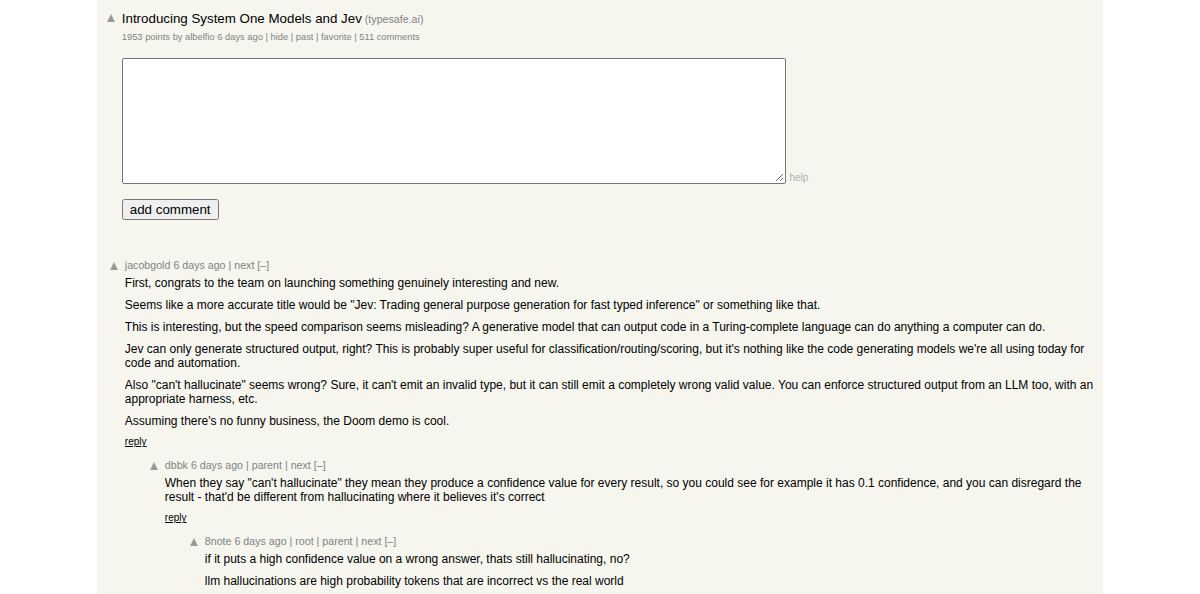
Introducing System One Models and Jev
The launch thread, and the largest single discussion of this model we can count. Start here for volume and for the objections raised in week one; the vendor's own announcement is in the resources column.
-
Hacker News
Jev in 25 Lines of Python
The most-read thread of the week, and it is a parody: a local Qwen model reproducing Jev's visible behaviour in twenty-five lines of Python. The discussion is better than the joke — the top comment asks for the latency and compute comparison the parody leaves out, which is exactly the measurement Jev's own case rests on.
-
Hacker News
Ollaya – Ollama for open-source, Jev-style decision models
The week's largest discussion of the decision-model stack: an Ollama-style daemon for open decision models behind TypeSafe's wire format. 587 points and 29 comments when we read it, and the argument in the comments is about whether a registry is the missing piece or another layer nobody needs.
-
Hacker News
Jeff – Jev-compatible 0.8B decision models, trained at home, ~30 ms
An 0.8B Jev-compatible decision model family you can train at home, shipped with GGUF builds, adapters and a hosted playground at jeffhub.ai. It is the most-discussed item in this column — 231 comments — and most of that argument is about whether a model this small holds up on real classification.
- Hacker News
Hacker News
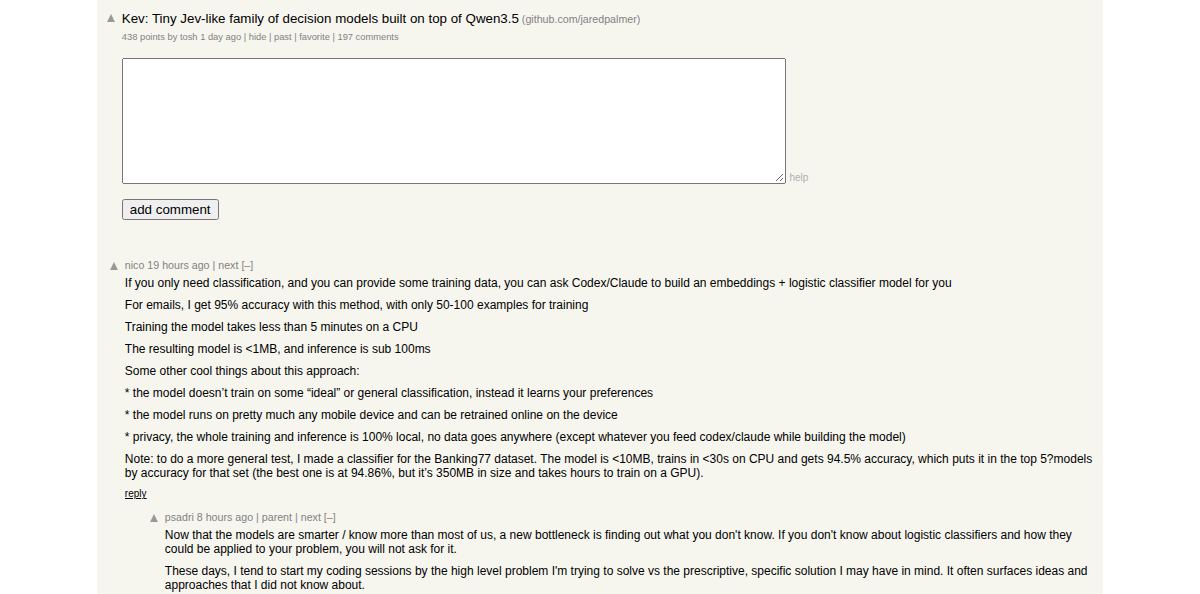
Kev: Tiny Jev-like family of decision models built on top of Qwen3.5
A third-party rebuild of the same idea on Qwen3.5 instead of a call to the hosted model. The clearest evidence that what people are copying is the decide-act loop, not the endpoint.
-
Hacker News
OpenAI is well positioned to fast-follow Jev
A 323-point argument that OpenAI is well positioned to fast-follow this shape of model, from a blog that writes about model economics. Whether or not the prediction lands, the thread is the clearest statement of the strategic question the launch raised.
-
Hacker News
Show HN: Jev Plays Pokémon Red
A Show HN that answers the first question anybody asks about a model this fast: can it play something harder than Tetris? Pokémon Red, open-sourced, with the author's own caveat that Jev is not yet fast enough for Doom. The comments are mostly about frame budgets and where the loop breaks.
-
Hacker News
Jeeves. Reasoning improves Jev-like decision models
PostHog's reasoning Jev-style classifier: a 9B model with a diffusion drafter, trained with SFT and CISPO, MIT-licensed with weights on Hugging Face. Its title carries the claim worth testing — that adding reasoning improves a decision model, which runs against the argument that speed is the whole point.
- Hacker News

Hacker News
Jev-Leftpad
The joke build: the decision pattern wrapped around a trivial utility. Worth reading as a size reference for how little code the smallest useful instance needs.
- Hacker News

Hacker News
I turned Jev into a (lousy) chatbot
Someone aimed a decision model at a job that belongs to a language model and said so in the title. The thread is the argument about where that line actually falls.
- Hacker News

Hacker News
Reverse-engineered Jev-like model
An independent reconstruction of the architecture. Read it next to the vendor's quickstart, because the two disagree in places worth knowing about.
-
Hacker News
Decision models like Jev don't beat LLM-as-a-judge or traditional classifiers
Red Hat's AI Safety team benchmarked nine guardrail candidates across four methodologies — CPU-scale pre-trained classifiers, LLM-as-a-judge and decision models — to ask whether Jev-style models earn their place for risk detection. It is the first enterprise-scale comparison we have seen on this question, and its answer leans toward the cheap old thing rather than either vendor's story.
-
Hacker News
Show HN: JevBench, a reproducible benchmark for typed decision models
The Hacker News thread for JevBench, the community benchmark that made comparison between these models possible. The most interesting comment quotes the vendor's own reasoning for not publishing benchmarks — which is a fair thing to have next to a benchmark somebody else wrote.
-
Hacker News
A single function Jev-like wrapper for LLMs, including vision models
A short argument with code: wrap any LLM — vision models included — in a single function that returns a decision rather than text. 135 points and 12 comments, and a useful counterweight to the framework-shaped projects in the builds column, because it shows how little scaffolding the idea actually needs.
- Hacker News

Hacker News
Open-sourced jev architecture last year with model,paper and dataset
A prior publication arguing the pattern predates this release, with the paper and dataset linked in the thread. Useful as the before-picture when the naming conversation comes up.
-
Hacker News
Jev – A curation of Jev demos on X, tools, skills, and integrations
A curation of demos, tools and integrations, submitted as a repository and argued about in the comments. Our own X column is the same idea with a person reading each row first; this is the version that scales by not reading them, and the comments show where that shows.
- Hacker News

Hacker News
Jev Ultrafast: A browser agent with a dynamic, indexed action space
A browser agent driving an indexed action space. We read this repository line by line for the resources column; the thread is where its author answers questions about it.
- Hacker News
Hacker News
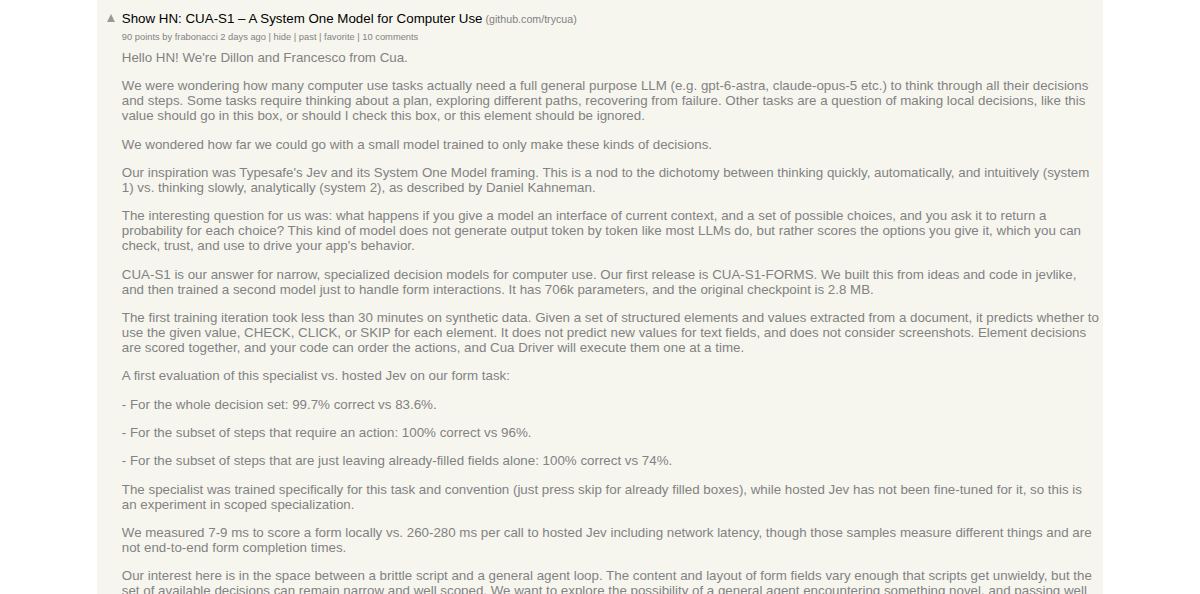
Show HN: CUA-S1 – A System One Model for Computer Use
A separate System One model, aimed at computer use rather than typed decisions. The clearest sign that the name is turning into a category rather than a product.
-
Hacker News
Turning GLM-5.3-Flash into a Jev-like decision model
PrivateMode's write-up of getting Jev-like behaviour out of a standard open model by crafting the prompt so the first output token is the answer: one forward pass, then a benchmark against both Jev and Laya. One of very few head-to-head measurements in this column that was not produced by a vendor.
-
Hacker News
Jev Can't Be Calibrated
The sceptic's post, and the most valuable one in this topic's discussion: four hundred rolls of a fair die, and the model's probabilities never moved off the first face. It is a one-experiment argument, so read it as a sharp case rather than a verdict — and note that it lands on the same failure the model's own card warns about.
-
Hacker News
What Is RLCD? The Secret Behind Jev
An explainer for the training method behind this class of model, with the objection attached: the top comment points out that the piece never defines the acronym in its own title. Useful as a pointer to the technique, not as the reference for it.
-
Hacker News
How accurately calibrated is Jev?
A measured attack on the calibration claim, with the whole experiment series run for under $4. The author's description of the architecture — a pre-trained transformer with a classifier bolted on the end — is the clearest short explanation of what Jev is that we have read from outside TypeSafe, whether or not the conclusion holds.
-
Hacker News
Jev introduces a new shape of LLM
Simon Willison's note on the launch, and the thread underneath is about what a closed decision model means for bias and audit: a probability you cannot interrogate is still a judgement. Worth reading for the questions rather than the answers.
-
Hacker News
Jev-Driven SRE Diagnosis: What Worked and What Failed
A research group handed Jev a view of a cluster and let its fast judgments choose where to investigate and which evidence supported a diagnosis, then published all 105 diagnoses including the ones that went wrong. Negative results with the failure cases printed are rare in this topic, and worth more than another demo.
-
Hacker News
Show HN: jevals – replacing LLM judges with typed Jev decisions
Replaces the LLM judge with a typed decision, which is the use case we expected to appear first and the one with the clearest failure mode. The thread's own objection is the one to keep: what happens when the judgement depends on context the typed decision cannot carry.
-
Hacker News
Show HN: Jeff – A read-only CLI for semantic code review using Jev
A read-only review CLI, and the thread argues about the word read-only rather than the model: one commenter points out that in a coding agent an edit is refused unless the file was already read in that conversation. Good thread for the enforcement question.
-
Hacker News
Jev, Prolog, Pi, and the dream of probabilistic logic programming
No comments yet, which is itself the interesting part: an essay putting Jev next to Prolog and probabilistic logic programming — the argument that a decision is a query, not a completion. Read it for where the idea came from.
-
dev.to · 11 min read
I got Jev to zero mistakes. I'm still using Flash-Lite.
An eleven-minute field report whose conclusion is in the title: the author got Jev to zero mistakes and still ships Gemini Flash-Lite. This is the useful shape of a negative result — not 'the decision model is bad', but 'here is the job where the cheap general model was already enough'.
-
Hacker News
Jev and System One Models: Calibration Beats Accuracy
A short essay with one claim worth keeping: for a decision model, a calibrated 0.83 that matches reality beats a confident answer that is often right. Thirteen points and seven comments — small, but it is the objection every accuracy table in this column invites.
- dev.to

dev.to · 6 min read
Valid Schema, Wrong Content: Using Jev to Guard a Google ADK Agent
A three-part write-up of putting the model in front of an agent as a guard, and discovering the failure mode that matters: the answer had the right shape and the wrong content. The schema was never the hard part.
-
dev.to · 11 min read
We Measured the 200x Claim, and Got It Wrong Twice First
A team trying to reproduce the price-performance headline, getting it wrong twice, and publishing both misses before the number they eventually stand behind. Method-first measurement writing is rare in this topic; this is the standard.
- dev.to

dev.to · 11 min read
What people are building with Jev: a look through nine awesome lists
Nine directories read in one sitting, with what each one collects. It is the closest thing to a census of the ecosystem's first week, and it is explicit that it is reading lists rather than testing projects.
- dev.to

dev.to · 5 min read
Jev Is Not an LLM. That Is the Point.
An argument about category rather than capability: most of what people call AI features are decisions, and decisions are the wrong thing to generate token by token. The framing is the same one the vendor uses; the post is included because it says it without the product around it.
- dev.to

dev.to · 14 min read
How Jev Works: The Logit Trick Behind TypeSafe's System One Model
An explanation of the mechanism rather than the marketing: how a bounded answer space becomes a probability without generating a token. Written by somebody who read the paper, and it is the piece to send anyone who asks what the model actually does.
- dev.to

dev.to · 6 min read
JEV assisted LLM Trading
A trading bot with the model as an auditor that never sees the strategy, only the proposed trade. Five comments for a reason: the split between proposing and approving is the interesting half, and the post says which side the model is on.
- dev.to

dev.to · 4 min read
Why Most Type-Safe Validation Fails in Production (And How JEV Fixes It)
The practical version of the argument: validation rules written as code rot, and a decision model is one way to move the judgement without moving the structure. The title overpromises and the body is a decent field report from a production system.
-
dev.to · 6 min read · AI-assisted
Your certificate inventory is exact. Your tickets are not.
Certificate renewals mapped to the tickets that track them, with the model deciding which ticket belongs to which certificate. Unglamorous operations work, stated plainly, which is what most adoption of this model will look like.
- dev.to

dev.to · 6 min read
Exploring Jev: A Hands-On Look at TypeSafe AI’s New Decision Model
A hands-on tour by somebody who had not read the launch material first, which makes it a useful check on how far a reader gets without the vendor's framing. One of the few first-person walkthroughs with the output shown.
- dev.to

dev.to · 5 min read · AI-assisted
Human, agents, code, judge: adding Jev without replacing peer review
A team adding the model to a review process without letting it take over the review, and describing where the human stayed in the loop. Most integration posts skip that half; this one is about it.
-
dev.to · 3 min read · AI-assisted
Jev in the Wild: The First Data-Driven Survey of 2,170 Jev Projects
A preprint surveying 2,170 public repositories that mention Jev, eight application domains and 1,865 new repositories in a week. The only attempt in this column to count the ecosystem rather than describe it — though the method is worth reading before the numbers, since repository counts measure enthusiasm as much as use.
- dev.to

dev.to · 9 min read
I Built a Fraud Agent using Jev That Can Trace a Transaction Across 590K+ Transactions
A fraud-investigation agent where Jev decides whether to look and the graph decides what is true, with deterministic rules and human approval keeping the last word. The architecture is the useful part: it shows where a decision model belongs in a pipeline that has to be auditable, and where it must not.
- dev.to

dev.to · 10 min read · AI-assisted
LLMs Generate. Jev Decides. Software Should Know the Difference
An integration write-up rather than a benchmark, and the framing is the reason it is here: the author's complaint is that we took a machine built to generate open-ended sequences and asked it politely not to be. He put Jev into a real Java invoice-processing application through The Pipeline Framework, found the old prompt already contained the list of answers, and reports that some of the work being sent to an LLM was never an LLM problem. Declared AI-assisted on dev.to.
- dev.to

dev.to · 6 min read
TypeSafe’s JEV Model: Is It Really 193x Faster and 444x Cheaper?
The independent check on the two numbers everyone quotes. They ran 100 support tickets through four question types against three frontier models — 400 decisions each — and measured 4x to 7x faster and 31x to 65x cheaper, not the 193x and 444x on the launch page. Their explanation is the useful part: a multiple is a property of the comparison, and the vendor compared against slow multi-step workflows while they compared against mid-tier single calls. They also reproduce the vendor's own side, a 474 ms median against the published 70-500 ms.
- dev.to

dev.to · 8 min read
Benchmarking Jev: what a decision model can (and can't) do in an agent harness
The most useful dev.to piece on this model so far: about 22,500 calls across ten public datasets, with the code and raw results in a companion repository. Half the value is the negative results — model-difficulty routing at 51% (no signal at all), trajectory failure attribution at 0.560 AUROC (random), and non-English retrieval well below English. The other half is two engineering lessons from iterating: decompose a fuzzy judgment into orthogonal questions and compose them in code, and let a choice compete before a noul verifies.
- dev.to

dev.to · 9 min read
I Rebuilt Jev's Structure with Qwen (Not Its Capabilities)
A reproduction of the architecture rather than the results, with the distinction in the title. Worth a row because that difference is the thing most 'I rebuilt it' posts blur, and this one does not.
-
dev.to · 10 min read
Jev vs a 310M encoder I trained myself: 750 rows, three tasks, two different winners
Somebody trained their own small encoder and compared it to the hosted model on three Japanese classification tasks. No reactions and no marketing — a person with a dataset, a hypothesis and a result, which is the kind of row this column exists for.
-
dev.to · 8 min read
Fixing Jev Decision Model AI Agent Overrides: A Flutter/Node.js Blueprint
A debugging write-up: an agent's override logic fighting the model's decisions, and the pattern that fixed it across two runtimes. Narrow, concrete, and the kind of thing that only exists once somebody has actually shipped.
- dev.to

dev.to · 8 min read
Searching for Better Game Recommendations with Jev
A personal project using the model to score game recommendations, including the part where the author's own code was steering the model toward the answer it expected. Catching that in your own pipeline is the value here.
-
dev.to · 2 min read
I Ran 300 Real Jev Calls on a Simulated Robot Fleet. The Bill Was $0.00737.
Three hundred calls to a simulated robot fleet for well under a cent, with the calls and the invoice kept separate so a reader can check the arithmetic. The cheapest demonstration in this batch of what the pricing model implies.
-
dev.to · 2 min read
Your AI judge says 98% confident. Does it mean it?
The calibration question written for people about to put a model in a compliance path: a confidence number is only useful if somebody checked what it means. It asks the question our own probe answers for this model, and it asks it generally.
-
dev.to · 1 min read
Testing TypeSafe Jev, Mistral and Gemini for local event validation
A team with early access tested all three on their own task: validating local event data. The comparison is narrow and the write-up says so, which is more useful than another sweep of public benchmarks.
- dev.to

dev.to · 8 min read
Stopping a crawl when the data stops looking real
A scraper that asks the model whether the page it just fetched still looks like real data, and stops the crawl when the answer is no. A homely, specific use of the pattern, which is how most of this model's real adoption looks.
- dev.to

dev.to · 13 min read
Jev vs Flash LLMs: 7x Cheaper on Workflows, Same Cost on One Label
The comparison that matters for a bill rather than a benchmark: on one label the cheap chat models are competitive, on a workflow of several questions the decision model pulls away. The crossover is the finding, and the post shows where it is.
- dev.to

dev.to · 4 min read · AI-assisted
Jev vs Claude for OpenPoke: 5.8x Faster Email Screening in a Small Test
A small, honest test — one task, a handful of emails, a stated speed ratio — from somebody building an assistant. Small tests like this are how adoption actually happens, and the post does not dress it up as a benchmark.
- dev.to

dev.to · 8 min read · AI-assisted
Jev Does Not Play Dice: 83% probability, 19% accuracy on a hidden fair die roll
The same fair-die experiment the Hacker News post above ran, written up from the other direction: the model was confident and wrong on a genuinely random process. Two independent people found the same edge in the same week, which is why both rows are here.
- dev.to

dev.to · 1 min read · AI-assisted
It took me 18 hours to add Jev
Eighteen months to build the pipeline and eighteen hours to add the decision model to it, retold without a victory lap. The ratio is the point: this model's integration cost is small enough to be a weekend, and that is why so many of these rows exist.
- dev.to

dev.to · 7 min read · AI-assisted
Jev Was Full, So My Agent Moved Into My Browser Instead
What happened when the hosted model hit its rate limit: the agent moved into the browser and kept working locally. A practical answer to the capacity question, found by a person who hit it rather than by a load test.
-
dev.to · 3 min read
A 25-line Jev parody shows why closed choices are not calibrated decisions
An analysis of the twenty-five-line parody: what it does and does not reproduce, and why the visible behaviour of answering a bounded question is not the same thing as calibration. It reads the parody closely instead of retweeting it.
-
dev.to · 20 min read
Before Adding a Jev-Type Judgment Model, Read Your Generation Model's Probabilities
An argument for looking at your generation model's own probabilities before adding a judgment layer: asking for a score and asking for a letter produce different behaviour, and the post works through which fits a classification path.
- dev.to

dev.to · 9 min read · AI-assisted
How I stopped misclassifying jobs with Jev!
The most concrete adoption story in this batch: a job-board operator replaces regex filters with a Jev judgment layer and names the miscategorisations it fixed — Java is not JavaScript, remote is not hybrid. First-hand, and it says what the old filter got wrong rather than only what the new one gets right.
- dev.to

dev.to · 4 min read
Pi‑warden: Using Jev to Block Destructive Commands in 48 Hours
A 48-hour guardrail build: Jev screens commands before an agent runs them, and the post states how many destructive calls it blocked in the author's own testing. The caveat is in the same post — a decision model is a filter, not a sandbox — which is the honest version of this idea.
- dev.to

dev.to · 7 min read
Jev Benchmarks, Read Carefully: Where 444x Cheaper Comes From
A sceptic reads the launch headline: where 193.6x faster and 444.6x cheaper come from, which chart they are drawn from, and which comparisons are apples to oranges. We disagree with nothing in it — the same objection is why our own price page prints its arithmetic.
- dev.to

dev.to · 8 min read
ML vs LLM for Classification: Jev, Decision Models, and the Triage Bot I Overbuilt
A first-hand account of overbuilding a triage bot and then cutting it back once the author understood what the model actually returns. Useful precisely because the first version was wrong and the post says so.
- dev.to

dev.to · 8 min read
TypeSafe AI Jev API Tutorial: Choice, Score, Noul and the Gotchas
A hands-on walk through the three question types with the mistakes the author made first, including a pointer to the docs page about jaggedness. Practical in the way quickstarts are not: it names the failure modes rather than the happy path.
What this column does not have
What this column covers, and what is still missing
Two sources: Hacker News, read through the Algolia API, and dev.to, read through its public API. Both were re-checked on 2026-10-09, because this column started as Hacker News only and the reference implementation we mapped it onto carries two sources:
- Reddit — the public JSON returns 403 without OAuth, and creating the app is still blocked; that is a dead end we have already written down once.
- Bluesky —
public.api.bsky.appanswers 403 to an unauthenticated search. - Lobsters — 400, "unpermitted query or form parameter".
- dev.to — 200, and now in. Its API is open and it already had thirty Jev posts, including two independent benchmarks.
Which is why the page is called "Jev in discussion" and not "Jev on Hacker News": it stopped being one forum today. The URL never said Hacker News, so nothing has to move for a source to be added — that was the point of naming the column after the shape rather than the site. What a reader should watch for is that the two platforms measure different things: Hacker News counts points, dev.to counts reactions, and a wall that printed both as "score" would be quietly lying about one of them. Each card says which number it is showing.
Videos. They are a separate column, because a thread is something you read and a video is something you watch — an index that mixes them makes you open both to find out which you got. The demonstrations and walkthroughs people recorded are collected under videos, and the things that came out of these threads with a repository attached are under what people built.
We also do not paste the comments. A thread is a conversation with its own permalinks, and a copy of it here would be both worse to read and out of date within a day — what we keep is the count, the date and our own reading, and the link goes to the thread itself.
Source: Hacker News via the Algolia API Every item linked, no content copied Jev topic